Build the Palace · Part 1
Your First Palace Is a Route, Not a Room
Choose a place, fix a short path through distinct landmarks, and practise finding each stop before you attach facts. The route gives your images an order you can revisit.
The question: What must be ready before the first fact enters a memory palace?
Big idea: A short route with distinct, retrievable stops gives new images an order; test the path before adding material.
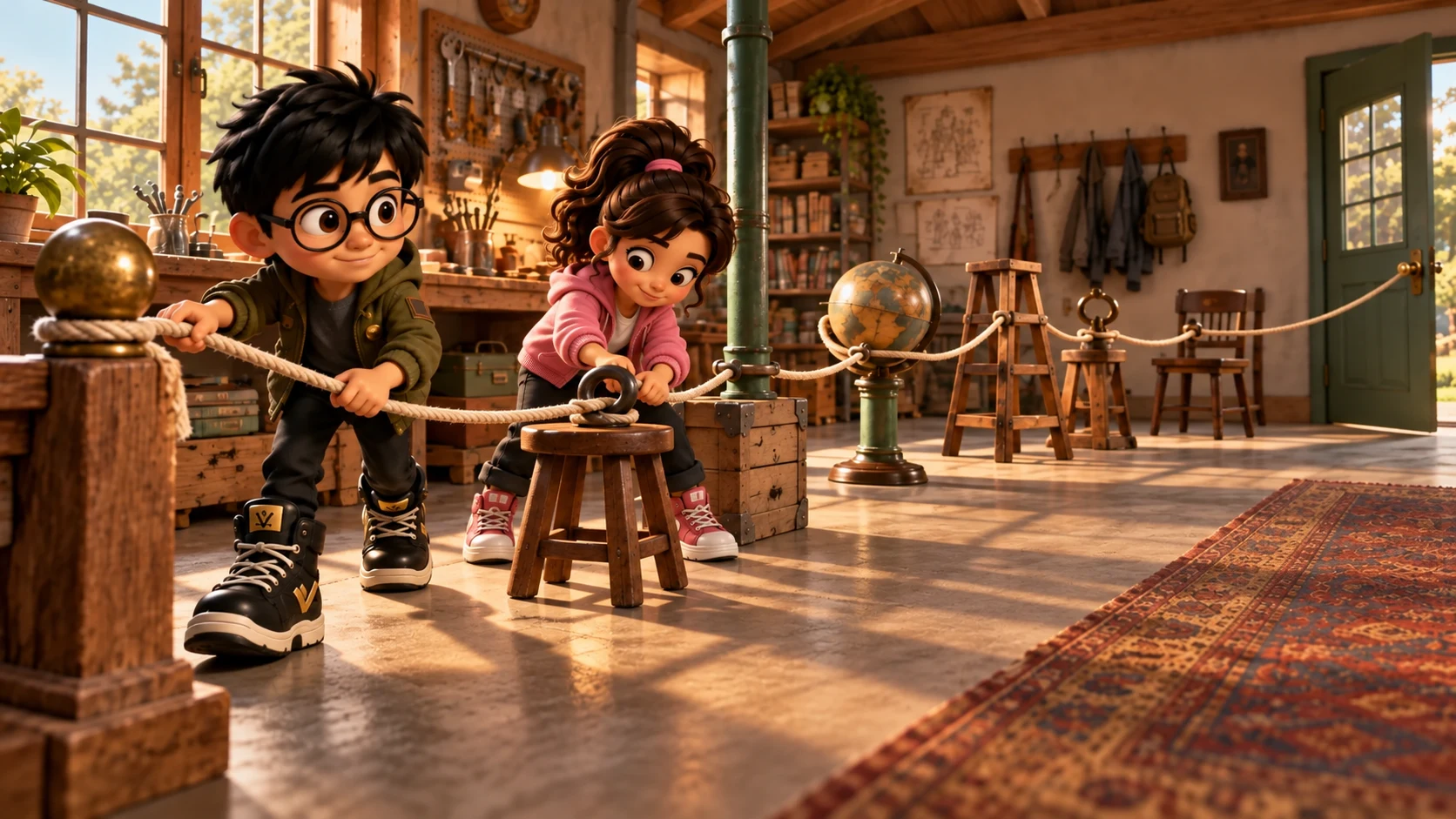
Imagine putting a short list into a familiar building. The images seem clear on your first walk. When you return, you can picture a few of them, but you cannot remember which doorway came after the window.
The pictures may be fading too. But if the path itself is uncertain, you have lost a set of cues that could help you find them. This lesson gives that path a deliberate order before you load it with material.
Why the ancient version starts the same way
The anonymous Rhetorica ad Herennium, written in the first century BCE, gives unusually practical advice about memory locations. Arrange them in a series that can be visited in either direction. Make them distinct; the author warns that similar places can become confused. The text also recommends moderate size, light, and distance between stops.
The ancient text treats places and images as separate parts of the method. It does not claim that route confusion is the only way memory can fail. It gives the learner a way to make the retrieval cues easier to find.
Frances Yates's The Art of Memory follows the technique through later European traditions. For a first attempt, you can use the simpler practical question in the ancient instructions: can you revisit your stops in the same order?
Choosing the place
You can start with a familiar building, a route you often walk, or a new place you learn or invent. Each needs the same check: can you bring its stops back in a stable order?
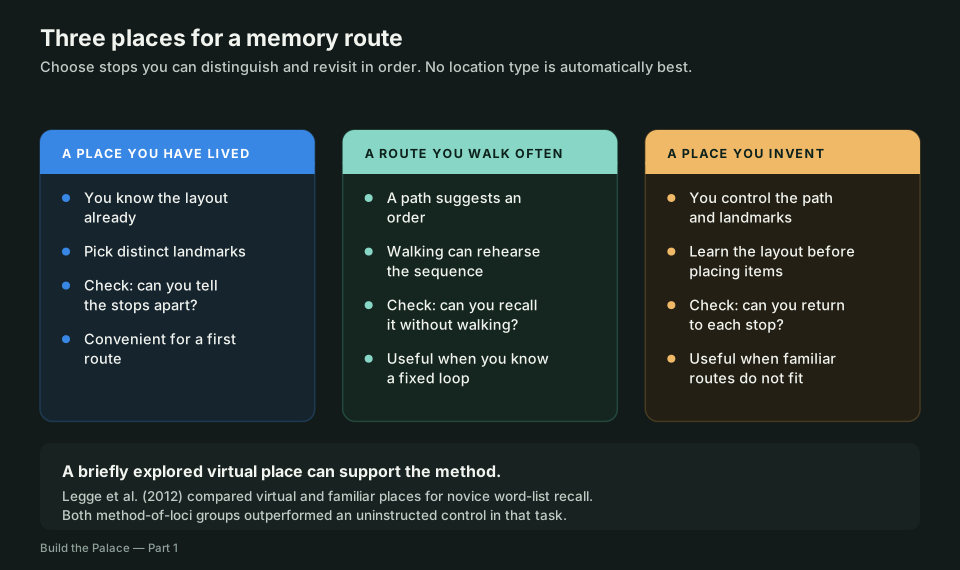
A place you know well supplies landmarks you can usually picture without learning a new map. A home is a convenient first candidate. Walk through it mentally and notice whether the stops are distinct enough that you will not confuse one with another.
A route you walk often may make the order easier to choose: a park loop or path to work already has a beginning and an end. Pick one traversal, even if the real route has branches. If the physical route changes, check whether the version you remember still gives you clear stops.
A new or invented place gives you control over the layout, but you must learn that layout as well as the list. A designed virtual room can provide visible landmarks; a place invented wholly in your mind needs its own practice. Neither earns an automatic advantage over a familiar place.
Legge and colleagues tested this choice in 2012. Novices used either a familiar place or a virtual environment explored for at most five minutes to remember lists of unrelated words in order. Both method-of-loci groups outperformed an uninstructed control group, and the virtual approach was about as effective as the conventional one on that task. The result supports a briefly learned virtual setting for serial word recall; it does not directly test a place invented without an environment to explore or long-term use.
A familiar place may save setup time because you already know its layout. Whichever you choose, test the route you will actually use.
The survey walk
Try this short preparation exercise. There is no research-backed number of minutes or stops that every first palace requires; start small enough to test the route without juggling its order.
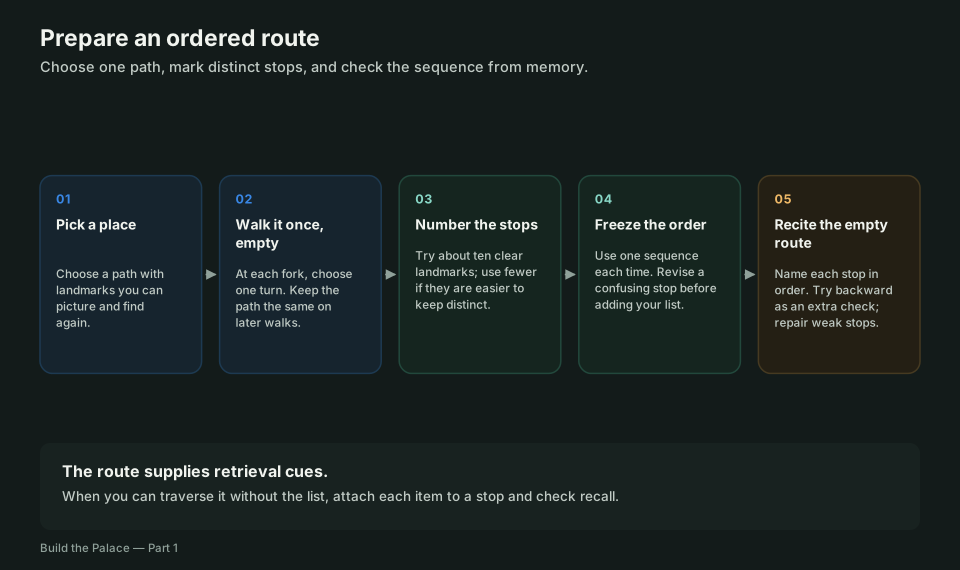
Walk it once with nothing in it. Start at a fixed point — a front door, a gate, a particular corner — and choose one path. A building may contain forks; your planned route only needs to make the next turn unambiguous. If you pass a location twice, use it as a stop only once or give the two visits unmistakably different cues.
Number distinct stops. Try about ten for this exercise; use fewer if that makes the path easier to learn. A stop might be a fireplace, bookshelf, or particular window. A room can also be a stop if it is distinctive enough for your task; several objects within one room can be separate stops if you can keep their order clear.
The ancient warning about similar places is a useful design check. If two stops blur together when you recite them, choose clearer landmarks or give them a more definite order.
Keep the order consistent. Use the same sequence on your practice walks. If a stop keeps causing confusion, revise it now and practise the revised route before adding the list.
Recite the empty route. Name the stops in order without looking. Try going backward as an extra check: the ad Herennium describes using a prepared series in either direction. For a task that only needs forward recall, the essential check is whether you can find the next stop reliably. Repair the places where you hesitate.
Now you have a route ready for a small list. Part 2 will show how to make each item interact with its stop.
How many stops, and how many palaces
The number of stops depends on the task. Ten is a manageable starting exercise, not a measured optimum. A short list may need fewer, and complex material may need more than one image or more than one route.
Reusing stops can make old and new items compete, but the evidence does not give a universal waiting period. De Beni and Cornoldi found retroactive interference when students learned three paired-word lists with the same loci. Massen and Vaterrodt-Plünnecke found that a different three-list task did not add more proactive interference for the method of loci than for other mnemonic methods. For material you want to keep, test the older list after learning the newer one; use a different route if the two lists start to collide.
Maguire and colleagues compared ten superior memorizers with ten controls in 2003. They found no exceptional general intellect or gross structural brain difference in that sample; during memory tasks, the memorizers reported spatial strategies and engaged brain areas involved in spatial memory. This shows a strategy associated with their performance, without proving that every learner will reach competition-level results.
What you should have at the end of today
For this first exercise, you can stop before storing a fact.
Aim to have one starting point and a short sequence of distinct stops you can recite from memory. If you can go backward too, you have another way to check the sequence.
That is your set of addresses. Part 2 is about building images that connect the material to those addresses.
Sources
- Anonymous (first century BCE). Rhetorica ad Herennium, Book III. Translated by Harry Caplan, Loeb Classical Library, 1954.
- Yates, F. A. (1966). The Art of Memory. University of Chicago Press.
- Legge, E. L. G., Madan, C. R., Ng, E. T., & Caplan, J. B. (2012). Building a memory palace in minutes: Equivalent memory performance using virtual versus conventional environments with the Method of Loci. Acta Psychologica, 141(3), 380–390.
- De Beni, R., & Cornoldi, C. (1988). Does the repeated use of loci create interference? Perceptual and Motor Skills, 67(2), 415–418.
- Massen, C., & Vaterrodt-Plünnecke, B. (2006). The role of proactive interference in mnemonic techniques. Memory, 14(2), 189–196.
- Maguire, E. A., Valentine, E. R., Wilding, J. M., & Kapur, N. (2003). Routes to remembering: the brains behind superior memory. Nature Neuroscience, 6(1), 90–95.