The Spatial Mind · Part 6
Engineering Memory Scenes: The Method, the Evidence, and the Limits
What controlled memory training actually improved, ten practical prompts for a route, and a six-week practice plan to test for yourself.
The question: How do you build a useful memory scene without mistaking the method for understanding?
Big idea: Start with a familiar ordered route, make cues that point to the intended ideas, and test recall with checking; judge the method by the tasks it helps you perform.

The previous lessons found a practical opening: a familiar place can become a cue for material that is hard to recall. That is a strategy to test, not a claim that every memory is filed by location.
The method of loci is old, and controlled training studies show that people can learn it. The measured gains concern particular recall tasks; the method still has to earn its place in your own study routine.
The origin story is a legend — the method is not
The traditional tale: at a banquet in ancient Greece, the poet Simonides of Ceos steps outside; the roof collapses; the bodies are unidentifiable; Simonides names every victim by recalling where each had been sitting. From this, the art of memory.
It is a good story and it is almost certainly not history. It reaches us through Cicero's De Oratore, written around 55 BCE — roughly four centuries after Simonides lived. Frances Yates, whose The Art of Memory is the definitive scholarly account, treats it as tradition rather than record.
What is documented is that the technique itself — the method of loci — appears in classical rhetoric, survived through medieval and Renaissance memory arts, and is used by many competitive memory athletes.
Three lines of evidence
1. Expert memorizers used spatial strategies.
In 2003, Maguire, Valentine, Wilding and Kapur compared ten leading memorizers with ten matched controls using cognitive tests and brain imaging.
The researchers did not find a structural brain difference in this small sample. During the studied learning tasks, the experts recruited regions associated with spatial memory, including parts of the hippocampus and retrosplenial cortex. A null structural finding in ten people does not rule out every anatomical or developmental difference.
And nine of the ten reported using the method of loci.
2. Six weeks of training improved word-list recall.
Martin Dresler and colleagues studied whether novices could improve with training in 2017.
They studied 23 elite memory athletes and 51 male novices with no prior mnemonic training. After baseline testing, the novices were pseudo-randomly assigned to method-of-loci training, an active control doing working-memory n-back training, or a passive control. The two training groups did 40 sessions of 30 minutes over six weeks.
The test was free recall of 72 nouns. Everyone started around 26–30 words.
- Method of loci group: +35 words. Roughly 61 out of 72. (For scale: the elite athletes scored about 71 out of 72; the athletes' matched controls, about 40.)
- Working-memory training group: +11.
- Passive control: +7.

At the four-month follow-up, the trained group was still about 22 words above baseline when participants re-encoded the baseline word list and recalled it after 15 minutes. That tests whether a recall advantage remained; it is not a four-month test of untouched memory for the original list.
Resting-state functional connectivity shifted toward a pattern observed in the athletes, and the degree of similarity was associated with recall improvement. This is an association measured in this training comparison, not proof that a specific network change caused each word recalled.
3. It shows up across the wider literature — with real uncertainty attached.
A 2025 systematic review and meta-analysis in the British Journal of Psychology included 68 studies. Its qualitative analyses covered roughly 2,600 younger and 2,400 older adults. One quantitative estimate for young adults compared immediate serial recall with rehearsal (d ≈ 0.42, 936 participants); a separate older-adult estimate compared performance before and after training (d ≈ 1.05, 1,919 participants).
Those figures are not the same comparison and cannot be read as an age contrast. Both reported confidence intervals touch zero, and the review found substantial heterogeneity and signs of publication bias. It rated the underlying evidence for these groups as very low certainty. Its pooled adult estimate favored the method for immediate serial recall, but the authors warned against treating that number as a dependable promise for every learner or task.
The controlled training comparison is encouraging for word-list recall. The broader literature is more variable, and the evidence is narrower than a general memory upgrade.
Build a route you can revisit
Start with locations you can reliably bring to mind.
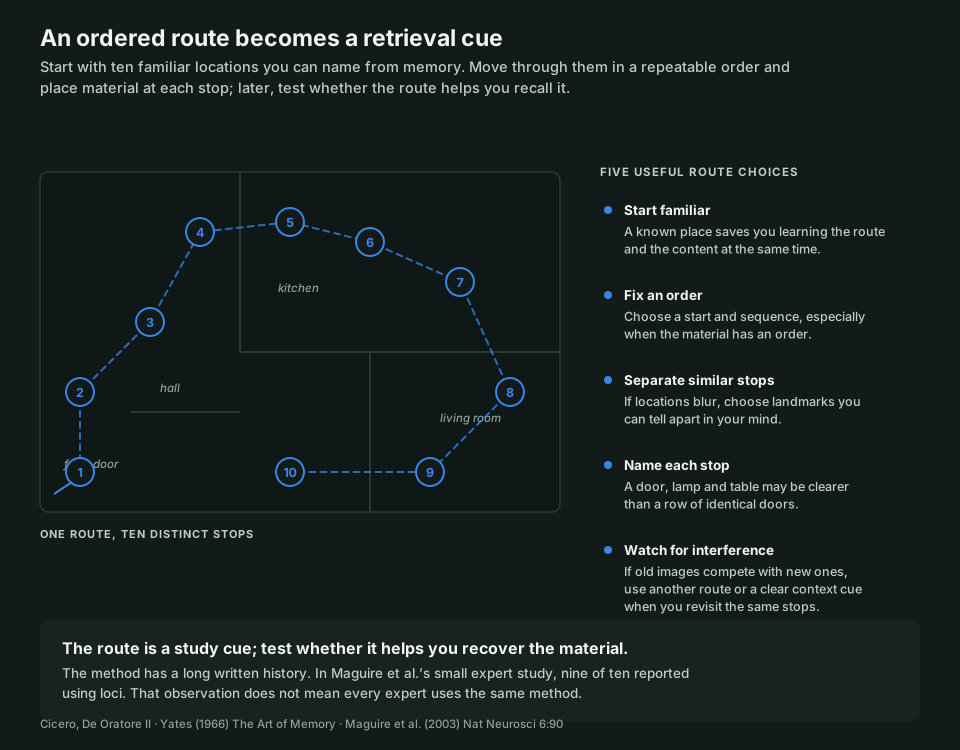
Start familiar. Your flat, commute, or an old school can save you the work of learning a route first. An invented or virtual place may also work if you know it well enough to revisit reliably.
Fix an order. Choose a starting point and a sequence of stops. This is especially useful when the order of the material matters.
Make stops easy to tell apart. If two spots blend together in your mind, choose more distinctive landmarks.
Name each stop. A door, lamp, and table are often easier to distinguish than a row of similar doors.
Watch for interference. When old and new images compete at the same stop, give the lists different routes or add a clear context cue.
Ten stops are enough for a first attempt. Walk the route from memory once or twice before adding content, then check that you can name each stop in order. Walking it backwards is an optional way to inspect how well you know the locations.
Ten prompts for the scene itself
The method-of-loci evidence supports using an ordered route. The prompts below combine practical design choices with findings about imagery, self-reference, generation, and retrieval; they have not been tested as one ten-part recipe.
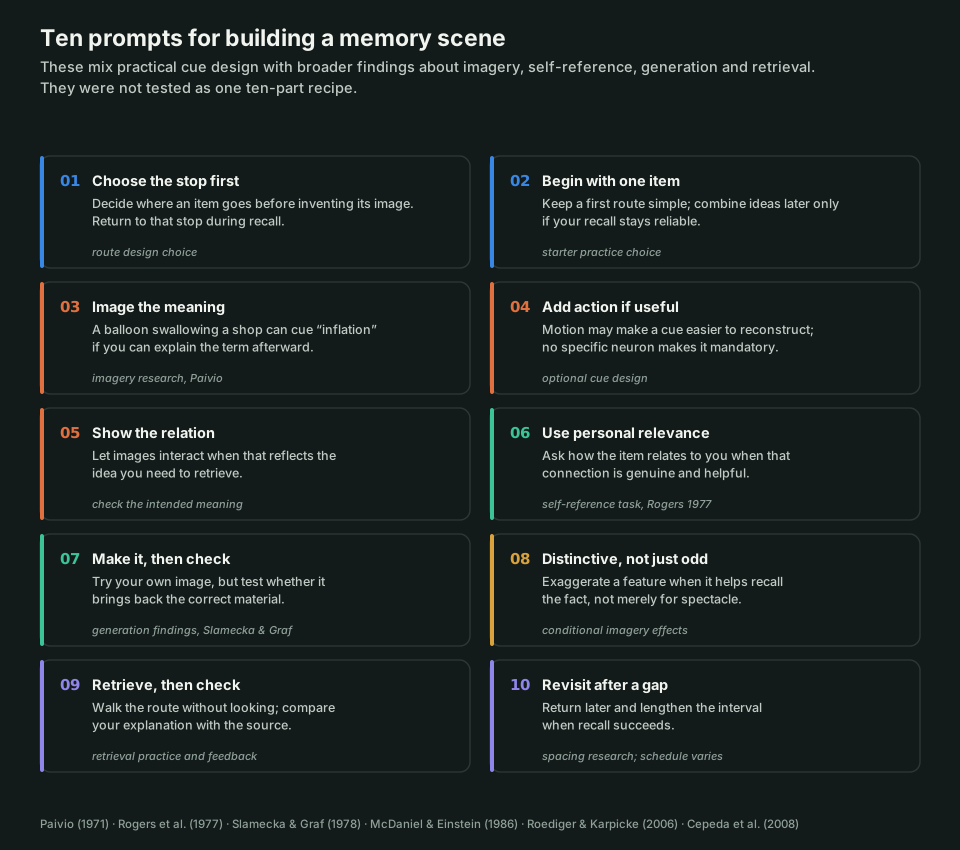
1. Choose the stop first. Decide where the item will go before inventing its image. The stop becomes the cue you will revisit.
2. Begin with one item per stop. This keeps a first route simple. Later you can combine related items if your own recall stays reliable.
3. Give hard-to-picture ideas a cue. You can picture a balloon swallowing a shopfront to cue inflation. Paivio's work helps explain why imageable material can be easier to recall, but the image must still point back to the correct definition.
4. Add an action when it helps. A balloon expanding around the shop suggests a change. An action can make a cue easier to reconstruct; no single action is required by a particular cell type.
5. Show the relation. If two terms depend on each other, let their images interact in a way that reflects that relationship. Check that the scene prompts the intended idea rather than a different story.
6. Use personal relevance when it fits. Rogers, Kuiper and Kirker (1977) found a self-reference advantage for judged words. That supports asking how an item relates to you; it does not show that you must physically stand inside every imagined scene.
7. Make the cue yourself, then check it. The generation effect shows benefits in some tasks when people produce material instead of reading it. It is a reason to try your own image, not proof that every self-made image beats every provided one or that a particular app performs poorly.
8. Make a cue distinctive, not merely strange. McDaniel and Einstein (1986) found that bizarre imagery can help under some list conditions. An exaggerated feature is useful only if it helps you retrieve the right meaning.
9. Retrieve, then check. Walk the route without looking, say what each image means, and compare your answer with the source. Retrieval practice can help retention; feedback catches errors before they settle in.
10. Return after a gap. Try recall later the same day, then on another day, and gradually extend the interval when you succeed. Research on spaced practice supports revisiting material over time; this exact schedule is a starter suggestion, not a tested optimum for loci.
A six-week practice plan to test

This is a starter plan, not the protocol tested by Dresler's group. Their participants practiced for 40 half-hour sessions, built several routes, and trained on word lists or images. Use the plan below to practice the same broad skill, and measure your own recall before treating it as useful.
Week 1 — build one route. Choose ten familiar stops in a set order. Walk it from memory until you can name the stops without looking. Try the reverse order if it helps you check distinctness.
Week 2 — put things in it. Start with ten concrete nouns, one at each stop. Recall later without looking, then check. Try a new list when you can distinguish it from the first; use another route if old images interfere.
Weeks 3–4 — try harder material. Turn a few abstract terms into scenes that cue their actual definitions. Record both the cue and the explanation so you can check them. Add stops or a second route if recall remains reliable.
Weeks 5–6 — test your use case. Compare recall and explanation for material you care about with your usual study method. Increase list length or reduce encoding time only if accuracy holds. Record how long encoding and checking take, not just the number recalled.
An example retrieval schedule: later the same day → next day → three days later → one week later → several weeks later. At each point, walk the route from memory, explain the items, then check the source. Shorten the next gap if recall fails; no study establishes these exact intervals as optimal for this plan.
What this will not do
I would rather you hear this from me than discover it.
It has not been shown to make you generally smarter. Li and colleagues (2021) compared loci training with dual n-back on two untrained working-memory tasks. Both groups improved on digit span; only the n-back group improved on change detection in that study. This is limited evidence about transfer, not a verdict on every ability or learner.
The strongest quantitative evidence concerns recall. The 2025 pooled estimate addresses immediate serial recall against rehearsal, and Dresler's headline result used free recall. Some studies also include recognition, but these findings do not establish a general recognition benefit or a proven lack of one.
It takes preparation. Building a route and images costs time. For a short-lived list, compare that cost with simpler rehearsal or notes; the method is useful only when the recall benefit is worth it.
It does not remove the need for understanding. Loci store what you give them. Put in a formula you cannot derive and you will recall a formula you cannot derive.
Interference can happen. If old scenes compete with new ones at the same stop, change routes or add a clear context cue.
Ceilings vary. The training effects above are group means with real spread. Some people take to it immediately; others need longer than six weeks.
The end of the road
The series began with a map metaphor. The evidence now lets us keep a useful part of it without turning it into a universal theory of memory.
Spatial-navigation systems support physical routes, and some experiments report map-like signals in learned nonspatial tasks. Those studies differ in species and measurements. Separately, expert memorizers often use spatial strategies, and one controlled six-week comparison found large gains in 72-word free recall for novices taught the method of loci. None of this proves that every memory needs a spatial address.
The practical upshot is small enough to hold in one hand.
A familiar place can give a hard-to-recall idea another cue.
Build one, then test whether it helps you recall and explain what matters.
Sources
- Cicero, De Oratore, Book II; Yates, F. A. (1966). The Art of Memory.
- Maguire, E. A., Valentine, E. R., Wilding, J. M., & Kapur, N. (2003). Routes to remembering: the brains behind superior memory. Nature Neuroscience, 6(1), 90–95.
- Dresler, M., et al. (2017). Mnemonic training reshapes brain networks to support superior memory. Neuron, 93(5), 1227–1235.
- Twomey, C., & Kroneisen, M. (2021). The effectiveness of the loci method as a mnemonic device. Quarterly Journal of Experimental Psychology.
- Ondřej, J. (2025). The method of loci in the context of psychological research: a systematic review and meta-analysis. British Journal of Psychology, 116(4), 930–986.
- Paivio, A. (1971). Imagery and Verbal Processes; Paivio, Yuille & Madigan (1968) concreteness norms.
- Rogers, T. B., Kuiper, N. A., & Kirker, W. S. (1977). Self-reference and the encoding of personal information. JPSP, 35(9), 677–688.
- Slamecka, N. J., & Graf, P. (1978). The generation effect. JEP: HLM, 4(6), 592–604.
- McDaniel, M. A., & Einstein, G. O. (1986). Bizarre imagery as an effective memory aid. JEP: LMC, 12(1), 54–65.
- Roediger, H. L., & Karpicke, J. D. (2006). Psychological Science, 17(3), 249–255.
- Cepeda, N. J., et al. (2008). Psychological Science, 19(11), 1095–1102.
- Li, W., Zhang, Q., Qiao, H., Jin, D., Ngetich, R. K., Zhang, J., Jin, Z., & Li, L. (2021). Dual n-back working memory training evinces superior transfer effects compared to the method of loci. Scientific Reports, 11, 3072.