The Spatial Mind · Part 2
A Memory Is Not a Recording. It Is a Build.
Encoding, consolidation, retrieval, and sometimes reconsolidation. Mouse experiments, H.M.'s case, and sleep studies show how memory can change, and where the evidence stops.
The question: What changes when an experience becomes a memory and is later recalled?
Big idea: Memory is built through selective encoding, consolidation, and reconstruction; retrieval can sometimes change what was stored.

The camera metaphor is tempting: capture, store, and play back a faithful copy. It misses much of what the experiments show.
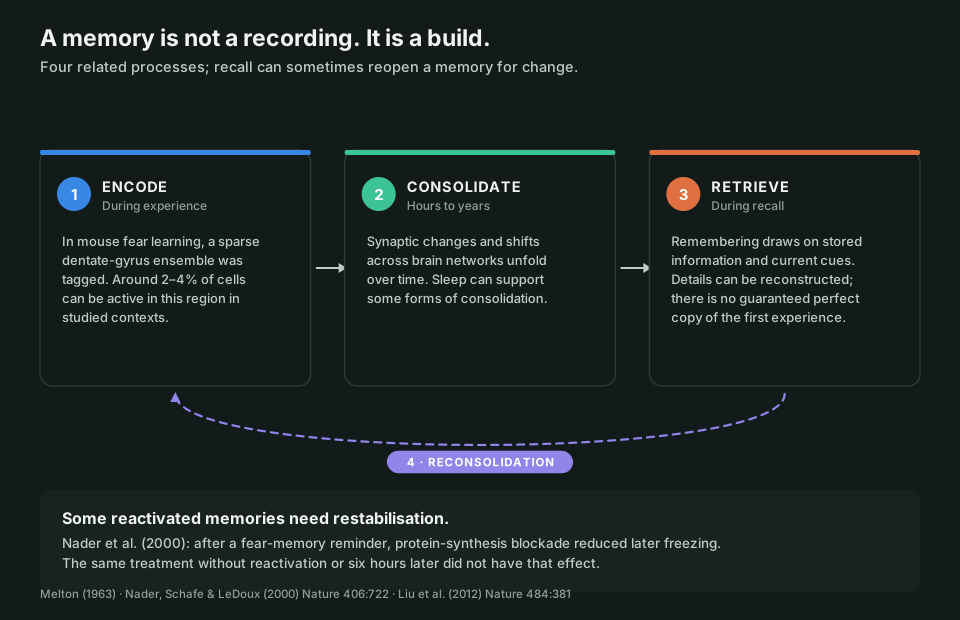
Experiences recruit patterns of activity. Some memories become more stable over time, and retrieval can draw on stored information and current cues. Under particular conditions, reactivation can also make a memory vulnerable to change. The stages below are a useful model, not one fixed sequence that every memory follows.
Stage 1 — Encoding: a sparse ensemble
In some mouse experiments, only a small fraction of dentate-gyrus granule cells become active in a studied context. One estimate is roughly 2–4%. That number describes a particular cell population and experimental setting, not a fixed share of neurons recruited for every human experience.
Susumu Tonegawa's lab then tested whether reactivating a tagged population could affect a learned response.
In 2012, Liu and colleagues tagged dentate-gyrus cells active while mice learned to fear one chamber, using a light-sensitive protein. Later, in a different chamber without shocks, the researchers stimulated the tagged cells with light.
The mice froze more during stimulation.
In this fear-conditioning task, activating a sparse, context-specific ensemble was sufficient to evoke a learned freezing response. That is strong causal evidence for the ensemble's role in recall. It does not mean that a complete memory lives in those cells alone or that the same result describes every kind of remembering.
A year later, Ramirez and colleagues tagged cells active in one chamber, then stimulated them while mice received shocks in another. The mice later froze in the first chamber, where no shock had occurred. The experiment created a false context–fear association in mice; it does not tell us what the animals experienced subjectively.
Stage 2 — Consolidation: two clocks, running at once
A newly learned association can change at synapses and across wider brain networks, on different timescales. The two clocks are useful ways to organize that evidence.
At the synapse (minutes to days). In 1973 Bliss and Lømo reported that strong stimulation of a hippocampal pathway in rabbits could leave its response potentiated for hours: long-term potentiation, or LTP. Later work identified NMDA receptors as coincidence detectors in a well-studied form of hippocampal LTP. Glutamate must bind while the postsynaptic membrane is sufficiently depolarised to relieve a magnesium block; calcium entry can then help trigger lasting changes. This is one plasticity mechanism, not a complete explanation of a memory.
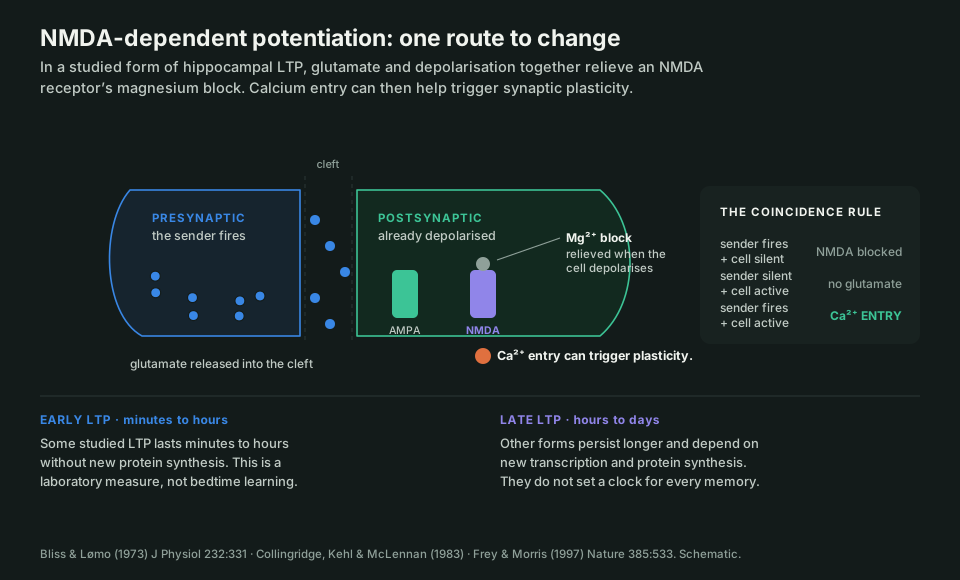
In some experimental preparations, early LTP lasts minutes to a few hours without new protein synthesis, while longer-lasting late LTP depends on gene transcription and protein synthesis. Those laboratory phases help researchers study persistence at synapses. They do not by themselves explain why a student's crammed material is forgotten days later.
Across networks (days to years). Interactions between hippocampus and cortex also change with time and experience. Standard consolidation theory proposes that some memories become less dependent on the hippocampus. Multiple trace and trace transformation accounts give the hippocampus a continuing role in detailed episodic recollection, even when a more general version can be supported elsewhere.
The models differ on what persists and what changes. Saying that every memory simply "moves to cortex" would hide that open question.
What H.M.'s surgery revealed
In 1953, surgeon William Scoville removed tissue from both medial temporal lobes of Henry Molaison, later known as H.M., to treat severe epilepsy. Scoville estimated an eight-centimetre resection including the anterior two-thirds of the hippocampus. Later MRI showed a smaller lesion: roughly the anterior half of the hippocampal formation, along with other medial temporal structures, was removed on both sides.
His seizures improved, but he developed profound difficulty forming lasting new declarative memories. He lived with that impairment for the remaining fifty-five years of his life.
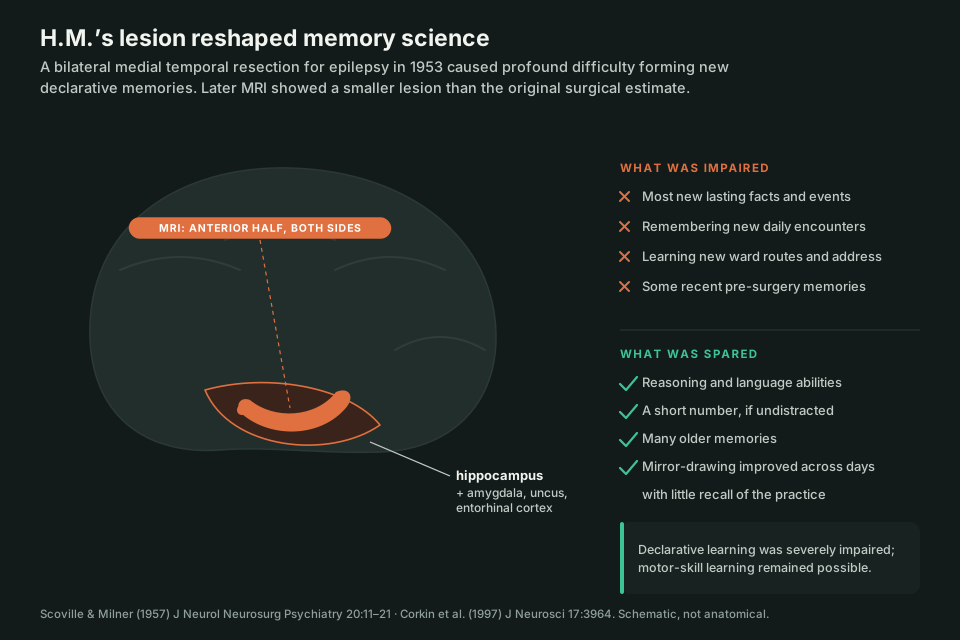
He read the same magazines repeatedly without recognising them. After the operation he struggled to find the bathroom on the ward, and months after his family moved he still had not learned the new address. Older memories were better preserved than recent ones, though his retrograde memory was not perfectly intact.
His general reasoning and language were comparatively preserved. He could hold a short number in mind for minutes if undistracted. In Brenda Milner's mirror-drawing task, he improved across practice sessions despite little explicit memory of having done the task before.
That dissociation helped establish that memory is not one faculty: forming new declarative memories and improving a practiced motor skill can depend on different circuits. Because H.M.'s lesion included several structures, his case cannot isolate the hippocampus alone as the cause of every deficit.
Stage 3 — Retrieval, and Stage 4 — Reconsolidation
Retrieval is more than opening a perfectly preserved file. A striking fear-learning experiment showed how a reactivated association can become vulnerable again.
In 2000, Nader, Schafe and LeDoux reactivated a previously learned tone–shock association in rats, then infused a protein-synthesis inhibitor into the amygdala.
The rats showed much less learned freezing on later tests.
The same treatment without reactivation did not produce that effect; delaying the infusion by six hours did not either. The result supported reconsolidation: under these test conditions, reactivation opened a time-limited window in which the association needed restabilisation.
The finding helps explain why researchers study reminders and updating in both animal and human memory. Reconsolidation has boundary conditions, however; the rat experiment alone does not establish one mechanism for eyewitness errors or a general method for treating traumatic memories.
For learning, the practical lesson is narrower: attempting to retrieve material can reveal what is available and give you another chance to study it. Part 3 examines the evidence for that practice.
The thing that happens while you are unconscious
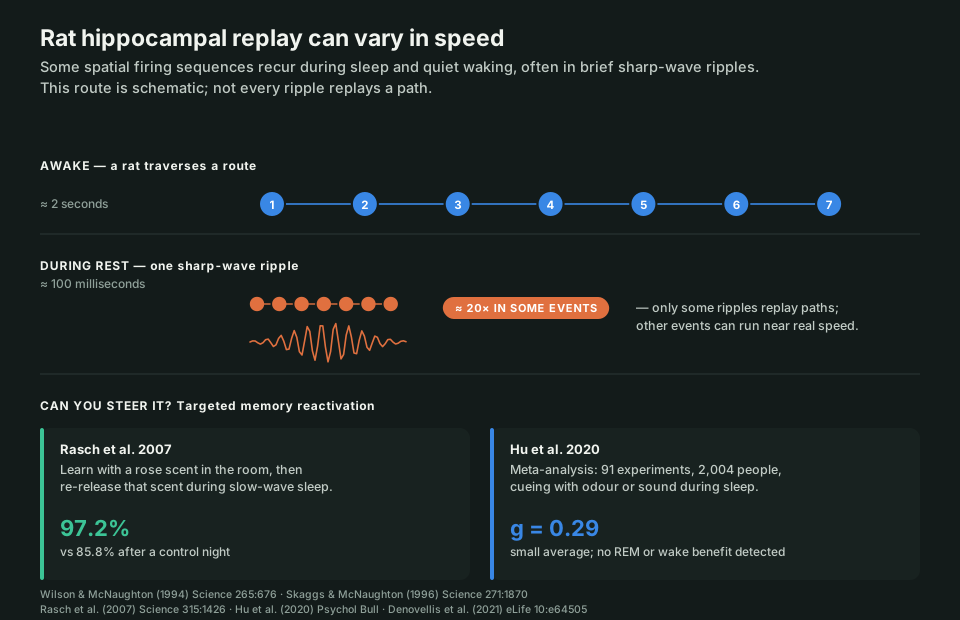
In 1994, Wilson and McNaughton recorded rat hippocampal cells during spatial exploration and later sleep. Cells active together during exploration tended to be coactive again during sleep. Skaggs and McNaughton later found evidence of ordered reactivation. Some brief sharp-wave ripple events contain spatial sequences compressed to around twenty times the animal's movement speed, but not every ripple contains such replay and replay need not run at one speed.
Denovellis and colleagues found rat replay events near reward locations that unfolded closer to real-world speed. Such activity is also observed during quiet waking, so the story is broader than "the brain reruns the day while asleep."
Then the obvious question: can you steer it?
In 2007, Rasch, Büchel, Gais and Born paired a rose scent with learning card locations. In one comparison, the participants recalled 97.2% of learned card pairs after a night when the scent returned during slow-wave sleep, versus 85.8% after a control night. Cueing during REM did not show the same benefit in that experiment.
Across Hu, Cheng, Chiu and Paller's 2020 meta-analysis of 91 experiments and 2,004 participants, sleep cueing had an average effect of Hedges' g = 0.29. Effects were detectable in non-REM sleep; the analyses did not detect a reliable benefit from cueing during REM sleep or wakefulness. That is a small average benefit under controlled conditions, not a promise that an odour will improve anyone's studying at home.
In 2025, Chang, Tang and colleagues found, in sleeping mice, that non-REM substates tracked by pupil size were associated with different reactivation patterns for recently learned and older information. Whether human sleep uses the same organisation remains open.
One myth to bury on the way out
For years, PKMζ was proposed as a crucial molecule for maintaining memories. A peptide called ZIP appeared to block it and could disrupt learned responses in animal experiments.
In 2013, Volk and colleagues found that mice lacking PKMζ could still learn, show LTP, and remain sensitive to ZIP. ZIP's effect therefore could not depend only on blocking PKMζ.
In 2025, Stokes and colleagues reported that ZIP and other positively charged peptides can remove newly inserted AMPA receptors from potentiated synapses through endophilin-related endocytosis. Their experiments identify an alternative route by which these peptides can disrupt memory in mice; they do not settle every role PKMζ might have in memory.
The episode is a useful calibration exercise: a striking intervention can be real while its first proposed explanation is wrong.
Where this leaves us
Encoding recruits distributed activity. Synaptic and wider-network processes can stabilise learned information over time, with sleep contributing to some forms of memory. Retrieval can reconstruct details, and under some conditions reactivation opens a window for change.
That gives you two useful questions for studying: what cues will help you retrieve an idea later, and can you produce it without seeing the answer?
Part 3 tests the second question against evidence from retrieval-practice experiments.
Sources
- Melton, A. W. (1963). Implications of short-term memory for a general theory of memory. JVLVB, 2(1), 1–21.
- Scoville, W. B., & Milner, B. (1957). Loss of recent memory after bilateral hippocampal lesions. J Neurol Neurosurg Psychiatry, 20, 11–21.
- Corkin, S., et al. (1997). H. M.'s medial temporal lobe lesion: findings from magnetic resonance imaging. Journal of Neuroscience, 17(10), 3964–3979.
- Milner, B., Corkin, S., & Teuber, H.-L. (1968). Further analysis of the hippocampal amnesic syndrome: 14-year follow-up study of H.M. Neuropsychologia, 6, 215–234.
- Liu, X., Ramirez, S., … Tonegawa, S. (2012). Optogenetic stimulation of a hippocampal engram activates fear memory recall. Nature, 484, 381–385.
- Ramirez, S., et al. (2013). Creating a false memory in the hippocampus. Science, 341(6144), 387–391.
- Bliss, T. V. P., & Lømo, T. (1973). Long-lasting potentiation of synaptic transmission in the dentate area of the anaesthetized rabbit following stimulation of the perforant path. Journal of Physiology, 232(2), 331–356.
- Collingridge, G. L., Kehl, S. J., & McLennan, H. (1983). Excitatory amino acids in synaptic transmission in the Schaffer collateral-commissural pathway of the rat hippocampus. Journal of Physiology, 334, 33–46.
- Frey, U., & Morris, R. G. M. (1997). Synaptic tagging and long-term potentiation. Nature, 385, 533–536.
- Nadel, L., & Moscovitch, M. (1997). Memory consolidation, retrograde amnesia and the hippocampal complex. Current Opinion in Neurobiology, 7(2), 217–227.
- Winocur, G., Moscovitch, M., & Bontempi, B. (2010). Memory formation and long-term retention in humans and animals: convergence towards a transformation account of hippocampal-neocortical interactions. Neuropsychologia, 48(8), 2339–2356.
- Nader, K., Schafe, G. E., & LeDoux, J. E. (2000). Fear memories require protein synthesis in the amygdala for reconsolidation after retrieval. Nature, 406, 722–726.
- Wilson, M. A., & McNaughton, B. L. (1994). Reactivation of hippocampal ensemble memories during sleep. Science, 265(5172), 676–679.
- Skaggs, W. E., & McNaughton, B. L. (1996). Replay of neuronal firing sequences in rat hippocampus during sleep. Science, 271(5257), 1870–1873.
- Denovellis, E. L., et al. (2021). Hippocampal replay of experience at real-world speeds. eLife, 10, e64505.
- Rasch, B., Büchel, C., Gais, S., & Born, J. (2007). Odor cues during slow-wave sleep prompt declarative memory consolidation. Science, 315(5817), 1426–1429.
- Hu, X., Cheng, L. Y., Chiu, M. H., & Paller, K. A. (2020). Promoting memory consolidation during sleep: A meta-analysis of targeted memory reactivation. Psychological Bulletin, 146(3), 218–244.
- Chang, H., Tang, W., et al. (2025). Sleep microstructure organizes memory replay. Nature, 637, 1161–1169.
- Volk, L. J., Bachman, J. L., Johnson, R., Yu, Y., & Huganir, R. L. (2013). PKM-ζ is not required for hippocampal synaptic plasticity, learning and memory. Nature, 493(7432), 420–423.
- Stokes, C., et al. (2025). Cationic peptides cause memory loss through endophilin-mediated endocytosis. Nature, 638, 479–489.