Build the Palace · Part 4
Route Knowledge, Survey Knowledge, and Why a Satnav Teaches You Nothing
You can drive a city for a year with a phone on the dashboard and still not know it. The reason is not laziness — it is that following a route and building a map are different operations, and only one of them leaves anything behind. The same split runs through everything you study.
The question: Why does following directions fail to build a flexible mental map?
Big idea: A practiced route helps ordered recall, while self-directed navigation and varied problems build the relational map needed for transfer.

Two people have been driving in the same city for a year.
One of them can get anywhere by following instructions and has never once been lost. Ask them how the neighbourhood they work in relates to the neighbourhood they live in — which is north of which, roughly how far apart, whether you could walk it — and they cannot say. Not vaguely; not at all.
The other gets lost occasionally and can answer the question immediately.
These two people have not learned different amounts. They have learned different kinds of thing, and the distinction is one of the more transferable ideas in cognitive science, because it is not really about cities.
Two kinds of spatial knowledge
Siegel and White proposed in 1975 that knowledge of a large environment develops in stages. First landmarks, then route knowledge — sequences of decisions strung between landmarks, "left at the church, past the bridge, second right" — and eventually survey knowledge, a configural representation in which places have positions relative to each other rather than positions along a path.
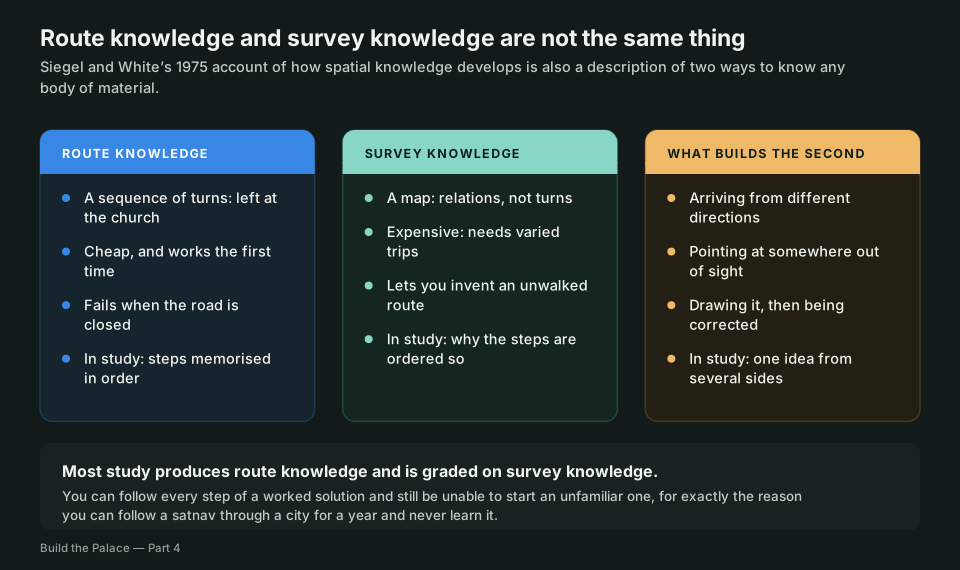
Route knowledge is cheap. You can acquire it on the first trip and it works immediately. It also fails completely the moment the route is blocked, because a sequence of turns contains no information about what to do instead.
Survey knowledge is expensive. It requires repeated, varied experience of the same space — arriving at a place from several directions, seeing how two routes relate, being made to commit to where something is. It buys you the ability to generate a route you have never taken.
The stage model has been argued over since — Ishikawa and Montello, in 2006, followed individuals learning real environments over ten weeks and found the neat progression is not universal; some people had good configural knowledge almost immediately, others never developed it despite the same exposure, and the variation between people was large. Treat the stages as two distinguishable kinds of knowledge rather than a staircase everyone climbs.
What the brain does when you stop deciding
The satnav question has been asked directly, and the answer is sharper than "you pay less attention".
Javadi and colleagues, in 2017, scanned people navigating a simulation of London's Soho. In one condition they navigated freely. In the other they followed turn-by-turn instructions.
During free navigation, hippocampal activity tracked the number of paths available at each junction — the structure of the network itself, not just the choice being made. Prefrontal activity tracked the difficulty of the upcoming route.
When participants followed instructions, those signals were not reduced. They were absent. There was no decision to make, so nothing had to be represented.
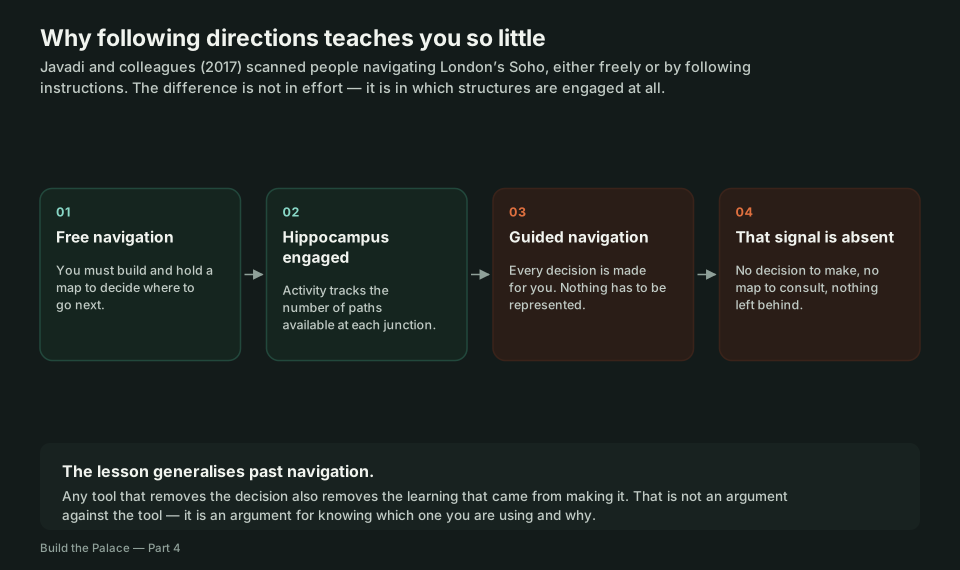
This is worth stating carefully, because it is easy to turn into an anti-technology sermon it does not support. The finding is not that satnavs damage you.
That is a mechanism, not a moral.
The London taxi drivers, and what they actually show
The famous counterpart is Maguire's work on London taxi drivers. Drivers who had passed "the Knowledge" — a licensing process requiring memorisation of some twenty-five thousand streets and the routes between them, typically taking three to four years — had larger posterior hippocampi than matched controls, and the size correlated with years of experience.
The obvious objection to the 2000 study was selection: perhaps people with large posterior hippocampi become taxi drivers. Woollett and Maguire answered it in 2011 by following trainees longitudinally. They scanned them before training and again three to four years later. Those who qualified showed increased posterior hippocampal grey matter. Those who trained and failed, and the controls, did not.
The change followed the learning. It was not there beforehand.
Two things are worth adding, because the study is usually quoted without them. The gain was not free: the qualified drivers showed worse performance on some other tasks involving new visuospatial information. And the training involved was extraordinary — years of full-time effort on one city. This is not a finding about a weekend of map-reading.
The part that is not about cities
Now the transferable version.
Almost all studying produces route knowledge. You follow a worked example: this step, then this step, then this one. It works the first time. You feel you have understood it, and you have — you have understood the route.
Then the exam gives you a problem that starts somewhere else, and you discover that you have no map. You cannot generate a path you have not been shown, for exactly the reason a satnav-driver cannot answer which neighbourhood is north of which.
What builds survey knowledge in a body of material is the same thing that builds it in a city:
- Arriving from different directions. Meeting one idea through several different problems, framings and examples, rather than one idea drilled in one form.
- Being made to commit. Pointing at where something is when you cannot see it, which in study means answering before you look — the testing effect again, arriving from a different direction itself.
- Producing it yourself and being corrected. Drawing the map from memory, finding it wrong, and fixing it. Sketch the structure of what you are learning without notes; the errors are the useful part.
- Varied practice rather than blocked practice. Interleaving problem types is harder in the moment and produces better transfer than doing twenty of one type in a row.
That last one is the clearest case of what Robert Bjork named a desirable difficulty: conditions that slow acquisition and improve retention and transfer. Blocked practice feels like it is going better, because within a block you know which method applies before you read the problem. That is the feeling of following instructions.
Where the palace sits in this
Here is the honest placement, and it is a limitation rather than a boast.
The memory palace is a device for building route knowledge deliberately and extremely well. It gives ordered material a fixed sequence of addresses and makes retrieval reliable. That is genuinely valuable, and it is what it does.
It does not build survey knowledge, and using it as though it did is the trap this whole series keeps circling. A perfectly walked palace containing the twelve steps of a procedure means you can produce the twelve steps. It does not mean you know why step seven is where it is, or what to do when the situation does not match.
Which is why the two belong together rather than in competition. Build the map by working the material from several directions; use the palace to make sure the parts you must produce cold are actually there when you reach for them.
Part 5 is the hardest case: material that has no picture in it at all.
Sources
- Siegel, A. W., & White, S. H. (1975). The development of spatial representations of large-scale environments. Advances in Child Development and Behavior, 10, 9–55.
- Ishikawa, T., & Montello, D. R. (2006). Spatial knowledge acquisition from direct experience in the environment: Individual differences in the development of metric knowledge. Cognitive Psychology, 52(2), 93–129.
- Javadi, A.-H., Emo, B., Howard, L. R., Zisch, F. E., Yu, Y., Knight, R., Pinelo Silva, J., & Spiers, H. J. (2017). Hippocampal and prefrontal processing of network topology to simulate the future. Nature Communications, 8, 14652.
- Maguire, E. A., Gadian, D. G., Johnsrude, I. S., Good, C. D., Ashburner, J., Frackowiak, R. S. J., & Frith, C. D. (2000). Navigation-related structural change in the hippocampi of taxi drivers. Proceedings of the National Academy of Sciences, 97(8), 4398–4403.
- Woollett, K., & Maguire, E. A. (2011). Acquiring "the Knowledge" of London's layout drives structural brain changes. Current Biology, 21(24), 2109–2114.
- Bjork, R. A. (1994). Memory and metamemory considerations in the training of human beings. In Metacognition: Knowing about Knowing. MIT Press.
- Rohrer, D., & Taylor, K. (2007). The shuffling of mathematics problems improves learning. Instructional Science, 35, 481–498.