Build the Palace · Part 5
Palaces for Things With No Picture: Code, Proofs and Systems
Everyone can picture an elephant. Nobody can picture amortised complexity. The method still works on material like this, but only if you stop trying to illustrate the idea and start doing something much more mechanical to it.
The question: What can a palace do for material that has no obvious picture?
Big idea: After understanding an abstract idea, give its required distinctions separate addresses and use physical interaction to cue cold production.

Every introduction to this method uses the same examples. A shopping list. A deck of cards. The presidents, in order. Nouns, all of them, and mostly concrete ones.
Then you try it on the thing you actually need to learn — a proof, an algorithm, the failure modes of a distributed system, the argument structure of a chapter — and the technique appears to evaporate. There is nothing to picture. An elephant is easy. Amortised is not a shape.
The usual conclusion is that the palace is for trivia and real material needs real study. That conclusion is wrong, but the usual counter-advice is worse: "just be more creative". What is actually needed is a different procedure, and it starts by abandoning the idea that you are illustrating anything.
Stop illustrating. Start addressing.
Here is the reframe the whole series has been building toward.
The palace does not work by making things vivid. It works by giving them coordinates. Vividness is a means, and not even the most important one — part 2 showed that the property that pays is interaction, which is a structural property, not a decorative one.
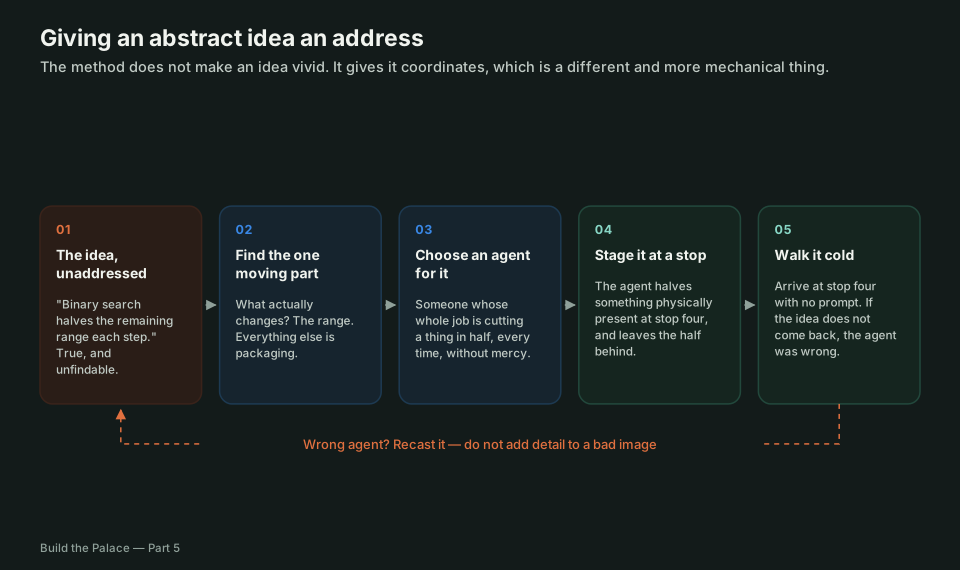
Find the one moving part. Every idea worth remembering has something that changes. In binary search it is the range, halving. In a mutex it is a single permission being held and released. In amortised analysis it is a cost being paid in advance and then drawn down. Strip the vocabulary away and ask what is actually in motion.
Choose an agent for that motion. Not a symbol of the idea — an agent whose entire job is the motion you just identified. Someone who cuts things in half, without mercy, every time. Someone who will not let a second person through a door until the first has come back out. Someone who makes everyone pay a small toll on the way in so that occasionally somebody gets a very expensive thing for free.
Stage it at a stop. The agent does the thing to something physically present at that stop, and leaves visible evidence. This is rule one of the grammar, unchanged.
Walk it cold. Arrive with no prompt. If the idea does not come back, the agent was wrong — not underdeveloped. Adding detail to a bad agent is the most common time sink in this whole practice. Recast it.
Why this is not a metaphor
There is a real objection here, and it deserves a straight answer: is this not just making an analogy, and are analogies not risky, since they leak?
Yes, and they do. The difference is what the image is for. A teaching analogy is supposed to make you understand the idea; when it leaks, you understand something false. A palace image is built after you understand the idea, and its job is retrieval, not explanation. It has to be sufficient to bring back a thing you already know — which is a far weaker requirement than being true.
That is also the safeguard. Build the image from your own understanding, at the point where you already have one. Never build it from the textbook sentence, because then the image encodes the sentence and you will retrieve a sentence you cannot use.
The evidence from part 3 is the guide here. The self-reference and generation effects both say the same thing in this context: the image works because you built it out of what you understood. Borrowed imagery for abstract material is close to useless, which is why published mnemonic sets for technical subjects tend to disappoint.
A worked example, at length
Take a claim from computer science with no picture in it: a hash table gives constant-time lookup on average, but degrades to linear time when many keys collide.
The moving part. Two things, actually, which is a warning: this needs two stops, per rule two of the grammar. The first part is that a key goes straight to its slot without searching. The second is what happens when several keys want the same slot.
Stop one. A hotel with a doorman who never checks a list. You say your name, he points directly at a door, and you walk to it. There is no searching, no matter how large the hotel is. That is constant time, and the image contains the reason — the name itself determines the door.
Stop two. The same corridor, later. Eight guests have been given the same door. They are queued in the corridor, and each new arrival has to walk past every person already waiting to find out whether their own room is free. The queue is the collision chain; the walk past it is the linear degradation. The image contains both the failure and its cause.
Notice what neither image contains: a picture of a hash function, an array, or anything with the word "hash" in it. Puns store labels. These store behaviour, and when you arrive at the corridor cold in two weeks, the queue does the work.
What this will not do
It is worth ending the series where it should end, rather than on a high note the evidence does not support.

It will not make you understand anything. Everything above assumes you already understood the idea and needed to be able to retrieve it. If the hash table example meant nothing to you, no image will fix that, and building one first would encode a misunderstanding in a form that is unusually hard to dislodge.
It will not transfer. Dresler and colleagues, in 2017, trained people with no prior mnemonic experience for six weeks, thirty minutes a day. Their word recall roughly doubled — from around twenty-six words to around sixty-one — and their resting-state brain connectivity shifted toward the pattern seen in world-class competitors. It is a striking result and it is also narrow: what improved was performance on the trained task. This is the same story as every other cognitive training literature. You get very good at the thing you practised.
It is not efficient for everything. Building a good image takes thirty to sixty seconds. For material you will need once, that is a bad trade. The palace earns its cost on material that is ordered, that you must produce without prompts, and that you will need repeatedly — which is a real category, and a much smaller one than enthusiasts imply.
The through-line
Six parts of The Spatial Mind argued that memory is a map running on navigation hardware, and that abstract material fails not because it is difficult but because it is unaddressed.
Five parts of this series have been the engineering consequence. Build a route before you build content. Make images act rather than merely exist. Retrieve rather than review. Know the difference between a route and a map, and do not mistake one for the other. And for material with no picture in it, find what moves, give it an agent, and give the agent an address.
None of this is new. Most of it was written down in Rome, in a textbook for law students, before anyone knew what a hippocampus was. What the last fifty years added is the reason it works — and, just as usefully, a clear account of what it does not do.
Sources
- Dresler, M., Shirer, W. R., Konrad, B. N., Müller, N. C. J., Wagner, I. C., Fernández, G., Czisch, M., & Greicius, M. D. (2017). Mnemonic training reshapes brain networks to support superior memory. Neuron, 93(5), 1227–1235.
- Ericsson, K. A., Chase, W. G., & Faloon, S. (1980). Acquisition of a memory skill. Science, 208(4448), 1181–1182.
- Slamecka, N. J., & Graf, P. (1978). The generation effect: Delineation of a phenomenon. Journal of Experimental Psychology: Human Learning and Memory, 4(6), 592–604.
- Dunlosky, J., Rawson, K. A., Marsh, E. J., Nathan, M. J., & Willingham, D. T. (2013). Improving students' learning with effective learning techniques. Psychological Science in the Public Interest, 14(1), 4–58.
- Maguire, E. A., Valentine, E. R., Wilding, J. M., & Kapur, N. (2003). Routes to remembering: the brains behind superior memory. Nature Neuroscience, 6(1), 90–95.
- Hassabis, D., & Maguire, E. A. (2007). Deconstructing episodic memory with construction. Trends in Cognitive Sciences, 11(7), 299–306.
- Anonymous (c. 80 BCE). Rhetorica ad Herennium, Book III. Translated by Harry Caplan, Loeb Classical Library, 1954.