The Spatial Mind · Part 3
Recognition Is Not Recall: Test What You Can Retrieve
A familiar page can make knowledge feel close at hand. Learn what recognition and recall each reveal, then use retrieval practice and spaced reviews to check what survives when the answer is hidden.
The question: Why can studying feel successful while a blank page defeats you?
Big idea: Recognising a supplied answer does not prove you can recall it later; attempt retrieval, check feedback, and revisit after a useful gap.

There is a moment everyone has had. You see a face at a party and think yes, I know this person — but cannot produce a name or recall where you met. You have a feeling of certainty without the details you need.
You may recognise the face and feel that it is familiar without retrieving the name. Those experiences give you different evidence about what you can produce when the answer is absent.
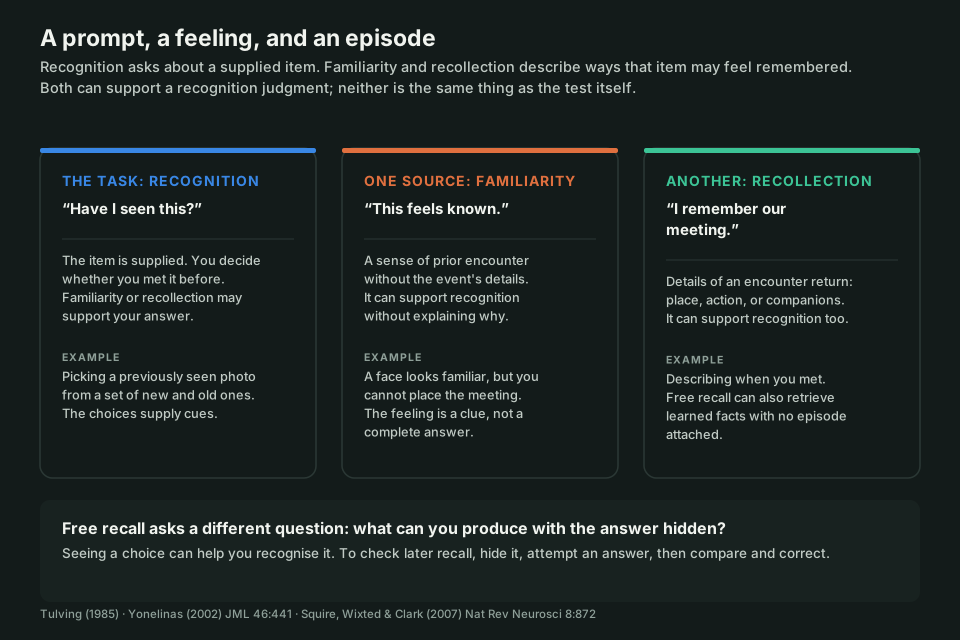
A test, a feeling, and an episode
Recognition is a task: the item is in front of you, and you judge whether you encountered it before. In the photograph experiment from Part 1, people identified previously seen images with about 83% accuracy after viewing 10,000 of them once. That result belongs to that recognition task; it does not tell us what the same people could describe with the images hidden.
Familiarity is the party feeling: a sense that the face is old to you, without the circumstances of the earlier encounter. It can support a recognition judgment even when you cannot say where you met.
Recollection brings back details of a particular encounter: where you were, who else was there, or what happened next. It too can support recognition. But a blank-page answer does not always require an episode: you can recall a learned fact without remembering when you learned it.
Tulving's remember/know procedure asks people who recognise an item whether they remember its earlier encounter or simply know it was there. Those reports help researchers investigate recognition; they do not by themselves prove two separate brain systems.
Researchers disagree about how much these reports reflect distinct processes, memory strength, or both. For studying, the safer distinction is between judging an answer you can see and producing one you cannot see. Success at one does not guarantee success at the other.
What the tip of the tongue reveals
The state is a vivid example of partial access.
In 1966, Brown and McNeill read definitions of uncommon words to 56 students and asked about words that seemed just out of reach.
Even without the word, participants sometimes knew its first letter, number of syllables, or sound pattern. They could retrieve pieces without retrieving the whole answer.
Retrieval is not always all-or-nothing. A clue can feel close while the answer remains unavailable. That is why a feeling of nearness is a poor substitute for trying to say the word.
The trap: fluency feels like knowing
Now the practical consequence.
In a survey of 177 undergraduates by Karpicke, Butler and Roediger, 54.8% ranked rereading as their main study strategy; 1.1% ranked self-testing first. In a forced-choice version answered by 101 students, 57% chose restudying, while 18% chose self-testing when it ruled out later restudy. In a different version answered by 76 students, self-testing could be followed by restudy and 42% chose it. The choices changed with the question, but the survey exposed how easily practice retrieval can be overlooked.
This is understandable. Rereading makes text easier to process in the moment.
That fluency can be mistaken for readiness to recall later. The visible page supplies words, order, and context that a later test may withhold. Reading can help you understand a new idea; smooth rereading alone is a weak check of whether you can retrieve it.
Retrieval can feel slower and less fluent. The useful part is attempting an answer, seeing the gap, and correcting it. Struggling without feedback or a successful follow-up is not automatically productive.
When the advantage reverses
In Roediger and Karpicke's 2006 first experiment, 120 undergraduates read short prose passages. For one passage they spent another seven minutes studying; for the other they spent seven minutes recalling it without feedback. Different groups then took the same free-recall test after five minutes, two days, or one week. The scores below are the share of passage ideas recalled in that experiment:
- Five minutes later: rereading 81%, testing 75%. Rereading wins.
- Two days later: rereading 54%, testing 68%.
- One week later: rereading 42%, testing 56%.
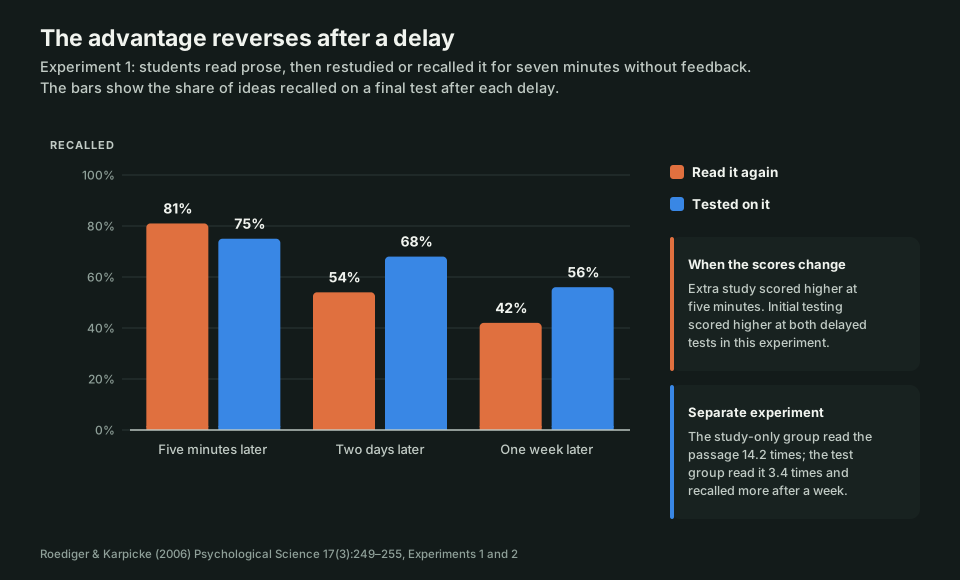
The short-delay result explains why an immediate self-check can flatter rereading. It does not mean rereading is useless, or that every exam and every topic will show these exact percentages. It means that an immediate feeling of ease is not the same as delayed retention.
In a second experiment, one group had four study periods; another had one study period and three free-recall tests. They read the full passage 14.2 versus 3.4 times on average. After a week, the testing group recalled 61% of its ideas versus 40% in the study-only group. Study periods lasted five minutes and test periods ten, so this comparison shows that extra exposure did not secure better delayed recall; it does not isolate effort or total time.
More rereading did not win this delayed test.
How study methods compare
Dunlosky and colleagues reviewed ten common techniques and rated their utility across learners, materials, and tasks:
- High utility: practice testing, distributed practice.
- Moderate: elaborative interrogation, self-explanation, interleaved practice.
- Low: summarisation, highlighting, the keyword mnemonic, imagery for text, rereading.
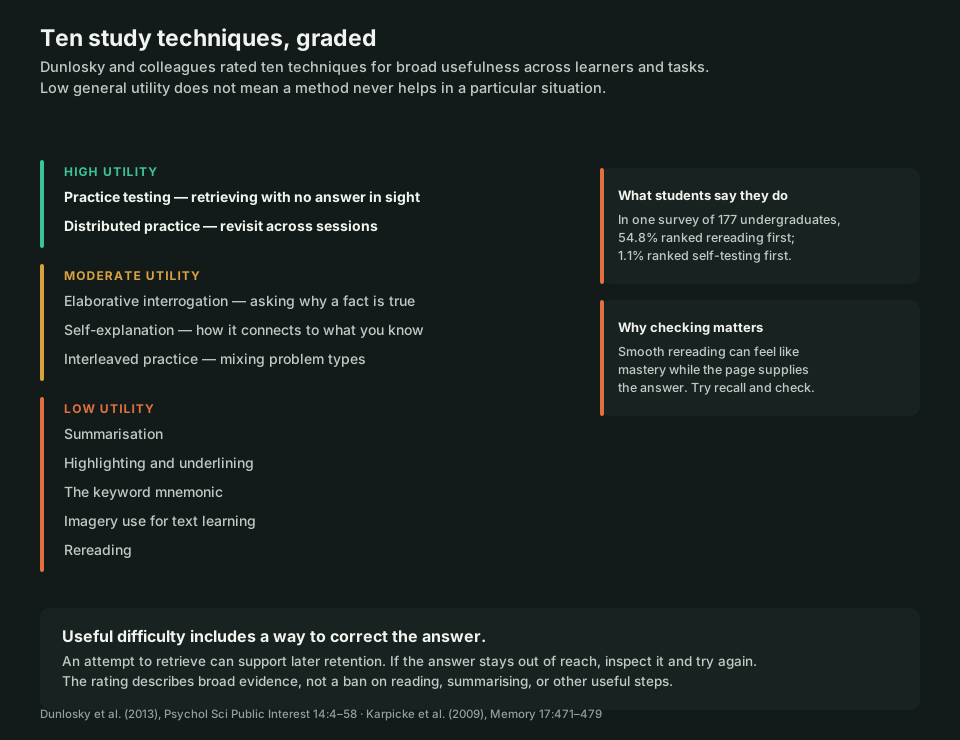
Practice testing and distributed practice earned high ratings because their benefits generalized broadly in that review. The moderate techniques can also help. Low utility means the evidence was less consistent or less general, not that a technique is worthless: reading can help on a first encounter, and rereading can help when it follows an attempt that revealed a gap.
Robert Bjork calls some useful learning conditions desirable difficulties: they can slow immediate performance while helping later retention. The word desirable matters. A retrieval attempt followed by useful feedback can help; confusion left unresolved is simply confusion.
How long to wait
Distributed practice is the other high-utility item. Its best gap depends partly on when you need the material again.
Cepeda and colleagues' 2006 review found 839 assessments across 317 experiments on spaced practice in verbal recall. In a 2008 experiment with 1,354 participants, they compared 26 combinations of a gap between two fact-learning sessions and a later test delay. Study gaps reached 3.5 months; final tests were delayed by as much as a year.
For each test delay in that experiment, later recall tended to improve as the learning gap widened, then decline when it became too long. The best gap grew with the target delay, but became a smaller fraction of it: roughly 20–40% of a one-week delay and 5–10% of a one-year delay. These are findings for that two-session fact-learning task, not fixed intervals for every future review.
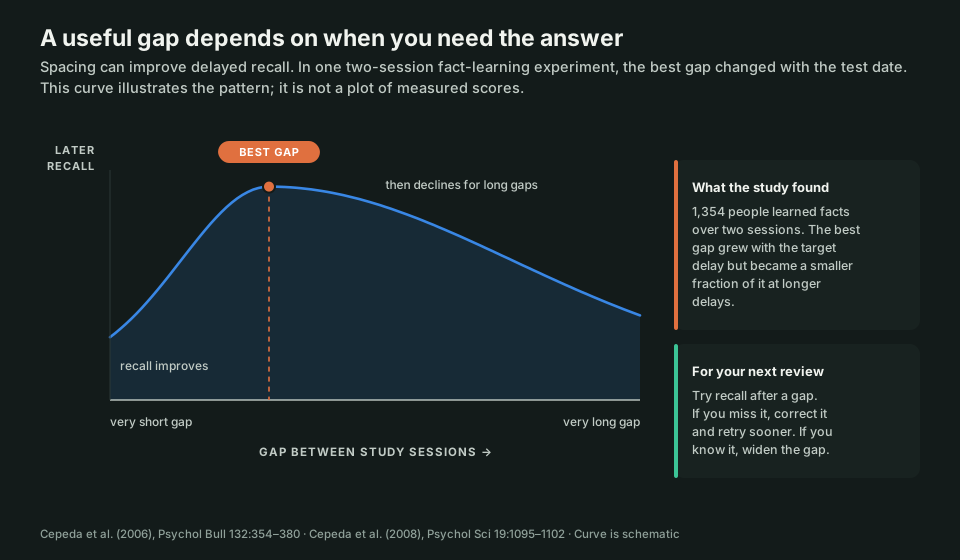
For practice, choose a gap that makes retrieval possible but requires some work, then adjust from your result. If you cannot produce the answer, use a cue or explanation, correct it, and try again sooner. If you can produce it reliably, widen the next gap. The days-long and multiweek gaps in the experiment are useful examples, not prescriptions.
And where you retrieve matters too
One more piece, because it sets up Part 4.
Tulving and Thomson's encoding specificity principle says a cue can help when it overlaps with what was present during learning. Godden and Baddeley tested one kind of contextual cue in 1975: scuba divers learned word lists on land or underwater, then recalled them in either environment.
Learned dry, recalled dry: 13.5 words. Learned dry, recalled wet: 8.6. Learned wet, recalled wet: 11.4. Learned wet, recalled dry: 8.4.
In both learning environments, the matching test setting produced higher average recall than the changed setting.
The environment helped cue these particular word lists. The result does not imply that learning only works if you return to the same place. You can deliberately practise retrieval with varied cues and settings if you need to use the knowledge elsewhere.
Part 4 looks more closely at how places and spatial cues can support memory.
The takeaway
Recognising a visible answer, feeling that it is familiar, remembering an episode, and recalling a fact are related experiences. They do not measure the same ability.
To learn for a future task, practise the kind of answer you will need to give. When the answer is hidden, try to retrieve it, check it, and return to it after a gap.
Sources
- Standing, L. (1973). Learning 10,000 pictures. Quarterly Journal of Experimental Psychology, 25(2), 207–222.
- Tulving, E. (1985). Memory and consciousness. Canadian Psychology, 26(1), 1–12.
- Yonelinas, A. P. (2002). The nature of recollection and familiarity: a review of 30 years of research. Journal of Memory and Language, 46(3), 441–517.
- Squire, L. R., Wixted, J. T., & Clark, R. E. (2007). Recognition memory and the medial temporal lobe: a new perspective. Nature Reviews Neuroscience, 8, 872–883.
- Brown, R., & McNeill, D. (1966). The “tip of the tongue” phenomenon. Journal of Verbal Learning and Verbal Behavior, 5(4), 325–337.
- Karpicke, J. D., Butler, A. C., & Roediger, H. L. (2009). Metacognitive strategies in student learning: do students practise retrieval when they study on their own? Memory, 17(4), 471–479.
- Roediger, H. L., & Karpicke, J. D. (2006). Test-enhanced learning: taking memory tests improves long-term retention. Psychological Science, 17(3), 249–255.
- Dunlosky, J., et al. (2013). Improving students' learning with effective learning techniques. Psychological Science in the Public Interest, 14(1), 4–58.
- Cepeda, N. J., et al. (2006). Distributed practice in verbal recall tasks. Psychological Bulletin, 132(3), 354–380.
- Cepeda, N. J., et al. (2008). Spacing effects in learning: a temporal ridgeline of optimal retention. Psychological Science, 19(11), 1095–1102.
- Tulving, E., & Thomson, D. M. (1973). Encoding specificity and retrieval processes in episodic memory. Psychological Review, 80(5), 352–373.
- Godden, D. R., & Baddeley, A. D. (1975). Context-dependent memory in two natural environments. British Journal of Psychology, 66(3), 325–331.
- Bjork, R. A. (1994). Memory and metamemory considerations in the training of human beings. In Metacognition: Knowing about knowing, 185–205.