Build the Palace · Part 2
The Encoding Grammar: Why Most Memory Images Die in Four Days
The advice everyone gets is to make the image vivid, bizarre and exaggerated. Two of those three are close to worthless, and the property that actually does the work is almost never mentioned.
The question: What makes one memory image survive after its initial vividness fades?
Big idea: A self-made scene lasts when one clear physical interaction binds the idea to its place and later cold retrieval tests that bond.
Ask anyone who has read one book about memory what makes an image stick, and you will get the same answer: make it weird. Make it huge, obscene, on fire, moving, absurd. The weirder the better.
This advice is repeated so consistently that it feels like a finding. It is closer to a folk belief, and the experiment that should have settled it was run in 1972.
The experiment that nobody quotes
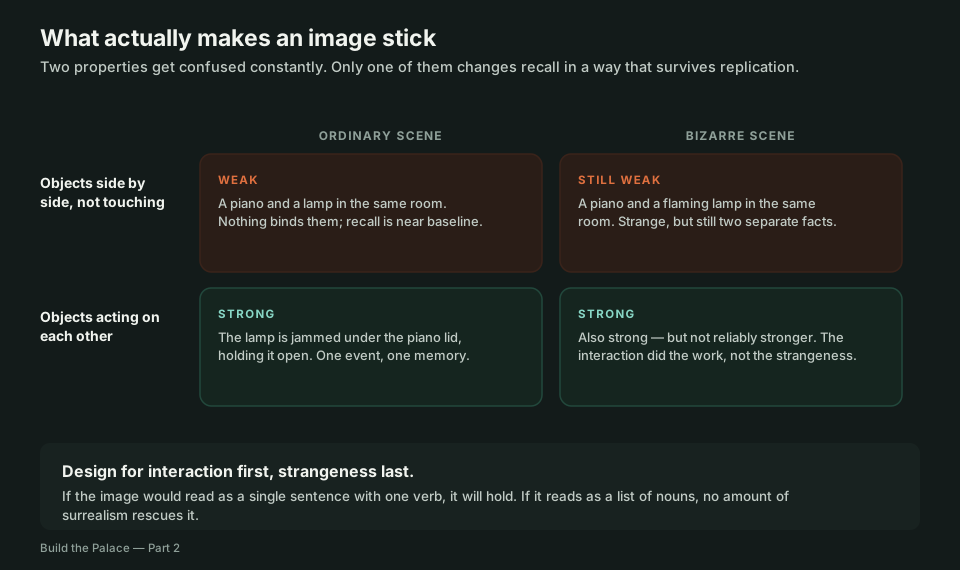
Wollen, Weber and Lowry set out to separate two things that get bundled together. Take a pair of words you need to associate — say piano and cigar. You can picture them in a scene that is bizarre or ordinary. Independently, you can picture them interacting or merely co-present.
That gives four conditions:
- Ordinary and non-interacting: a piano and a cigar sitting in the same room.
- Bizarre and non-interacting: a giant cigar and a piano sitting in the same room.
- Ordinary and interacting: the cigar resting in an ashtray on the piano.
- Bizarre and interacting: the piano smoking the cigar.
The result was clean. Interaction improved recall substantially. Bizarreness did not. The strange images were no better than the ordinary ones once you controlled for whether the objects were doing something to each other.
This is not a fringe result and it has not been overturned. What later work did was explain when bizarreness does help, and the explanation makes the original finding sharper rather than softer.
McDaniel and Einstein showed in 1986 that bizarre imagery helps in mixed lists — where some items are strange and others are not — and stops helping in pure lists where everything is strange. The effect is distinctiveness, not strangeness. An item stands out against its neighbours. If every neighbour is also on fire, nothing stands out, and you have paid the cost of constructing twenty surreal images for no return.
The six rules
Here is the whole grammar. Each one has an experimental result behind it, which is the only reason it is on the list.
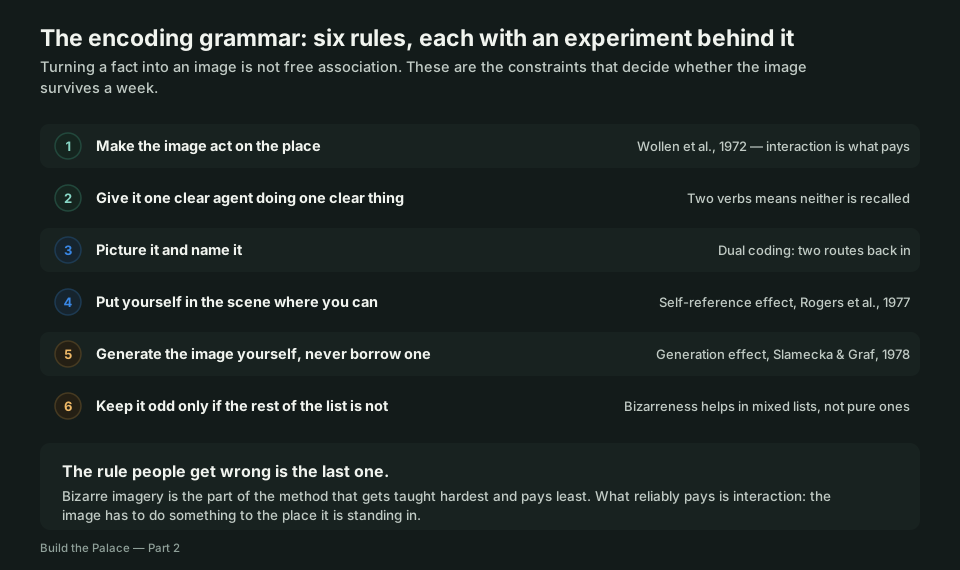
One: the image must act on the place. Not stand near it, not sit on it — act on it. The lamp is jammed under the piano lid holding it open. If your image would read as a list of nouns, it will not hold. If it reads as one sentence with one verb, it will.
Two: one agent, one action. Two things happening in the same image means that on retrieval you get one of them and lose the other, and you will not be able to tell which one you lost. If a fact needs two actions, it needs two stops.
Three: picture it and name it. Paivio's dual coding account is that verbal and visual codes are separate systems with separate retrieval routes, and material encoded in both is recoverable by either. In practice: after you build the image, say what it is, once, in words. It takes two seconds and it doubles the number of paths back.
Four: put yourself in it. The self-reference effect — Rogers, Kuiper and Kirker, 1977 — is one of the more robust findings in the encoding literature. Material processed in relation to oneself is remembered better than material processed for meaning alone, which is already better than material processed for surface features. If you can be the one holding the thing, be the one holding the thing.
Five: generate, never borrow. Slamecka and Graf's generation effect, 1978: material you produce yourself is retained better than identical material you read. This has a direct consequence that people dislike. Lists of ready-made mnemonic images — the standard number-shape systems, someone else's peg list — work far less well for you than they do for the person who wrote them. Their images are generated. Yours are borrowed.
Six: distinctiveness, not surrealism. Covered above. Use it where an item genuinely needs to stand out from its neighbours, and nowhere else.
The failure that looks like success
There is one more rule, and it does not fit on the chart because it is a diagnostic rather than a construction technique.
When you build an image, you will feel whether it is good. That feeling is not reliable, and it is not reliable in a specific direction: images feel strongest immediately after you build them, because you have just spent thirty seconds thinking about them and everything you just thought about feels available. This is the same illusion that makes rereading feel like studying.
The test is not "can I see it now". The test is "can I get it back tomorrow, cold, starting from the place and nothing else".
So build the image, move on, and do not evaluate it. Evaluate it on the first cold walk, which is part 3.
A worked example
Take a fact with no picture in it at all: the hippocampus is required for forming new declarative memories, but not for retrieving old ones.
The bad version — the one almost everyone builds first — is a hippopotamus at stop four. That is a pun on the name. It stores the word "hippocampus" and nothing about what the hippocampus does, and in a week you will arrive at stop four, find a hippo, and be unable to say why it is there.
The working version has to contain the asymmetry, because the asymmetry is the fact. So: at stop four, a doorman is stamping every new arrival's hand as they come in. People already inside walk past him freely; he does not look at them. Someone takes the doorman away, and from that moment nobody new gets stamped — but everybody already inside carries on exactly as before.
One agent. One action. It acts on the place. It contains the whole claim including the part that makes it interesting, and you can say it in a sentence, which satisfies rule three. Nothing in it is bizarre.
That is the grammar. Part 3 is about the walks that follow, and about the specific ways a working palace decays.
Sources
- Wollen, K. A., Weber, A., & Lowry, D. H. (1972). Bizarreness versus interaction of mental images as determinants of learning. Cognitive Psychology, 3(3), 518–523.
- McDaniel, M. A., & Einstein, G. O. (1986). Bizarre imagery as an effective memory aid: The importance of distinctiveness. Journal of Experimental Psychology: Learning, Memory, and Cognition, 12(1), 54–65.
- Paivio, A. (1986). Mental Representations: A Dual Coding Approach. Oxford University Press.
- Rogers, T. B., Kuiper, N. A., & Kirker, W. S. (1977). Self-reference and the encoding of personal information. Journal of Personality and Social Psychology, 35(9), 677–688.
- Slamecka, N. J., & Graf, P. (1978). The generation effect: Delineation of a phenomenon. Journal of Experimental Psychology: Human Learning and Memory, 4(6), 592–604.
- Craik, F. I. M., & Lockhart, R. S. (1972). Levels of processing: A framework for memory research. Journal of Verbal Learning and Verbal Behavior, 11(6), 671–684.
- Hunt, R. R., & Worthen, J. B. (Eds.) (2006). Distinctiveness and Memory. Oxford University Press.