The Spatial Mind · Part 5
Maps Beyond Places: How Relationships Can Cue Recall
Studies find map-like signals while people navigate learned relationships, including bird features and odour mixtures. Those findings suggest a useful analogy for recall, with limits that matter.
The question: Can the brain map relationships even when there is no physical landscape?
Big idea: In tested tasks, navigation-related regions show map-like signals for learned nonspatial relations; a familiar scene can also be used as a deliberate retrieval cue, without explaining all knowledge.
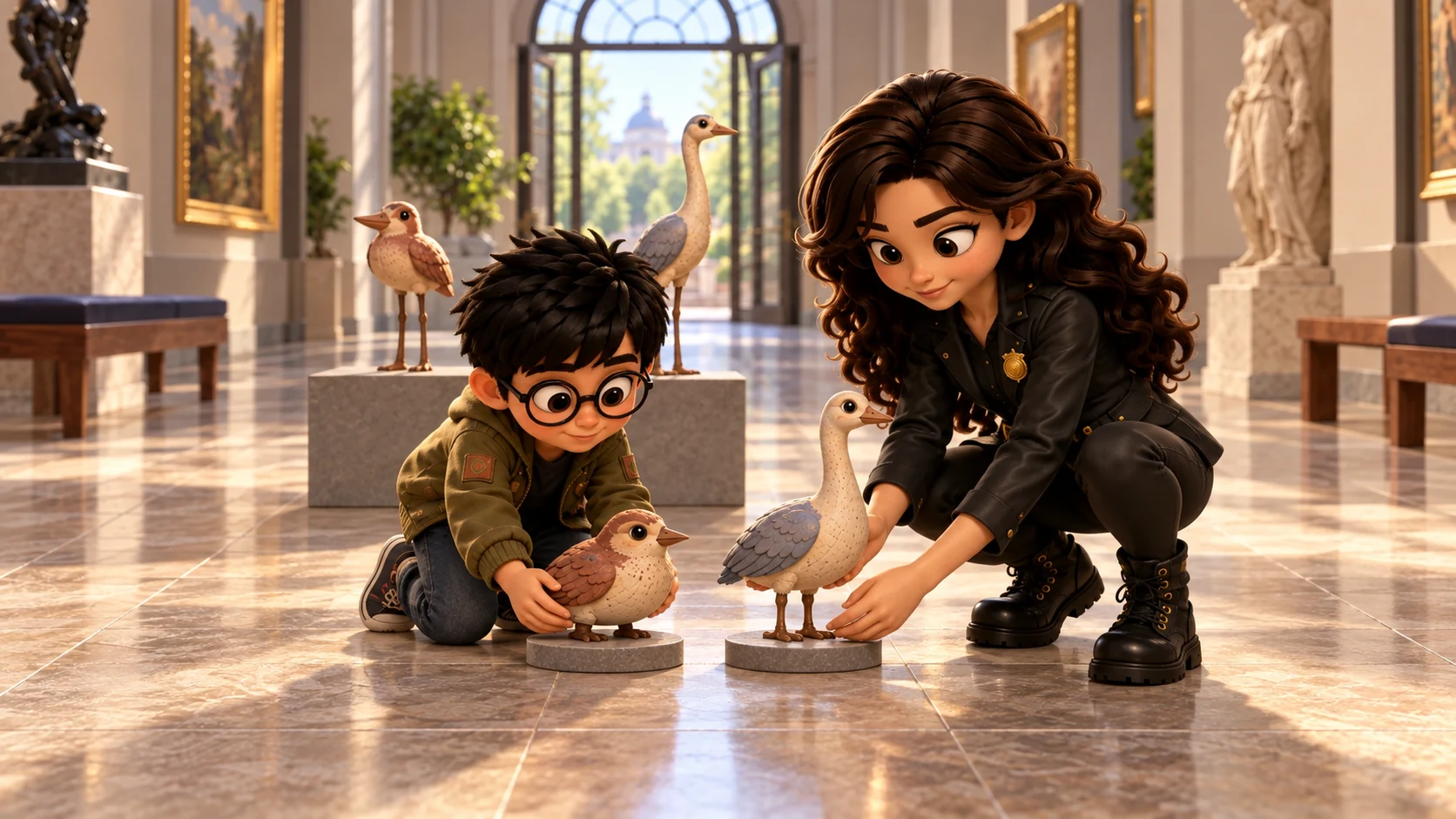
Part 4 looked at cells involved in spatial navigation. Can a learned set of relationships also be represented in a map-like way, even when nobody moves through a physical room?
Several experiments suggest that this can happen in specific tasks. They also raise a practical question: if a new fact is hard to retrieve, can we give it a familiar relation that helps us find it again?
Birds that do not exist
In 2016, Alexandra Constantinescu, Jill O'Reilly and Timothy Behrens tested whether people could learn a conceptual space and navigate it without crossing a room.
They built a two-dimensional space out of cartoon birds. One axis was neck length. The other was leg length. Changing either feature moved a bird to a new position in that learned feature space. Participants learned associations between birds and outcomes before the scan.
Then they were scanned while "moving" between birds.
During the scan, participants evaluated transitions between birds. The researchers looked for a six-fold modulation in the fMRI signal by direction of travel through the feature space. This is a population-level signature consistent with grid-like coding; fMRI did not record the firing of individual grid cells. The team also tested whether the estimated orientation held across sessions.
They reported grid-like signals in regions including entorhinal and ventromedial prefrontal cortex, with some measures related to task performance. The result supports map-like representation of this learned two-dimensional space. It does not show that every concept uses the same cells or that every idea is stored as a location.
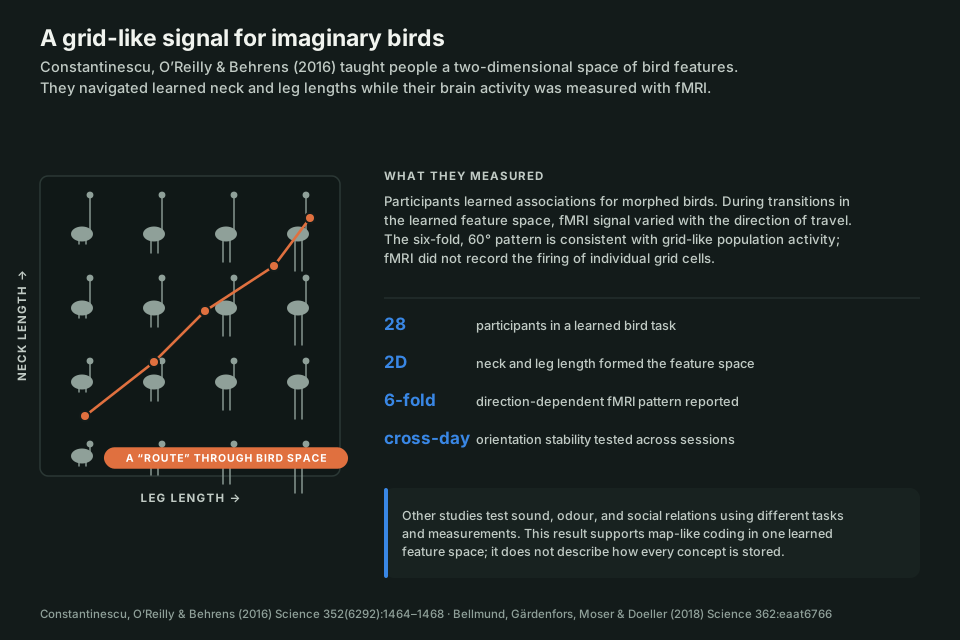
There was no physical floor in the task. The measured pattern resembled a spatial-navigation signature, but the experiment tested one carefully designed feature space.
Related maps, different tests
Other studies tested nonspatial relationships with different tasks and measurements:
Social relationships. Tavares and colleagues (2015) had people make decisions in a story where characters varied in power and affiliation. Hippocampal activity tracked aspects of those social relationships. In a separate task, Park, Miller and Boorman (2021) found grid-like fMRI evidence as participants inferred relationships in a learned, two-dimensional social hierarchy. Neither task placed people on a literal floor map.
Sound. Aronov, Nevers and Tank (2017) trained rats to change a tone's frequency with a joystick while remaining in place. Some recorded hippocampal and entorhinal neurons had firing fields along the frequency axis. These were direct neuronal recordings in rats, a different kind of evidence from the human fMRI studies.
Smell. Bao and colleagues (2019) asked people to navigate a two-dimensional space of odour mixtures. They reported grid-like fMRI signals associated with performance in that task.
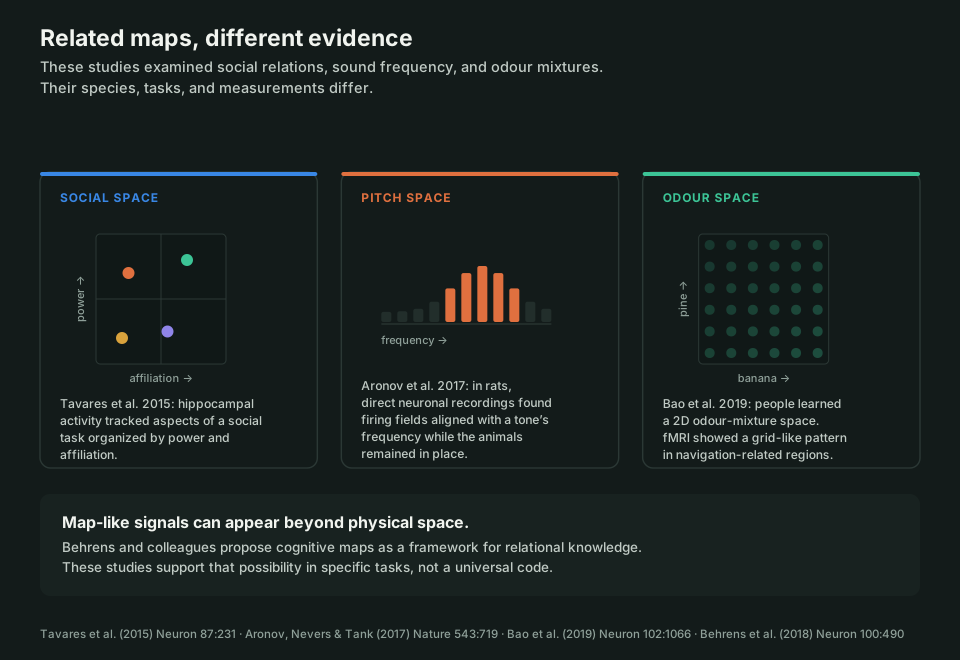
Behrens and colleagues' 2018 review proposes a broader idea: map-like representations may help the brain learn and use relations across tasks. That is a framework for interpreting varied findings, not evidence that all knowledge uses one code or transfers instantly between domains.
Bellmund and colleagues titled their review "Navigating cognition: spatial codes for human thinking." The title captures the research direction. The experiments above still differ in species, tasks, and what was measured.
The useful conclusion is narrower and more interesting: spatial-navigation circuitry can also participate when some nonspatial relationships are learned or inferred.
What a spatial cue gives an abstract idea
The neuroscience does not redefine abstract. An abstract idea can have rich logical structure without being tied to a picture or a place. The practical question is whether you have a reliable cue for bringing a particular idea back when you need it.
Related cues can help bring learned material to mind, but a vivid scene does not guarantee understanding or later recall. You have to try retrieving the fact after a delay.
Consider one result from Part 4: in rats, Stensola and colleagues measured a mean scale ratio of 1.42 between adjacent grid modules, close to √2.
The number may be easy to recognize on a page and hard to produce unaided later. We can give it an extra cue without pretending that the imagined scene is how rat neurons store it.
Now consider the same fact, placed:
On your kitchen counter, two people stretch a giant honeycomb until each gap is roughly 1.4 times wider. The bees are furious.
The kitchen and stretching action can prompt you to recall the ratio. Then you must check the actual claim: 1.42 was a mean measured in rat grid modules, not a law for every grid or for every type of thought.
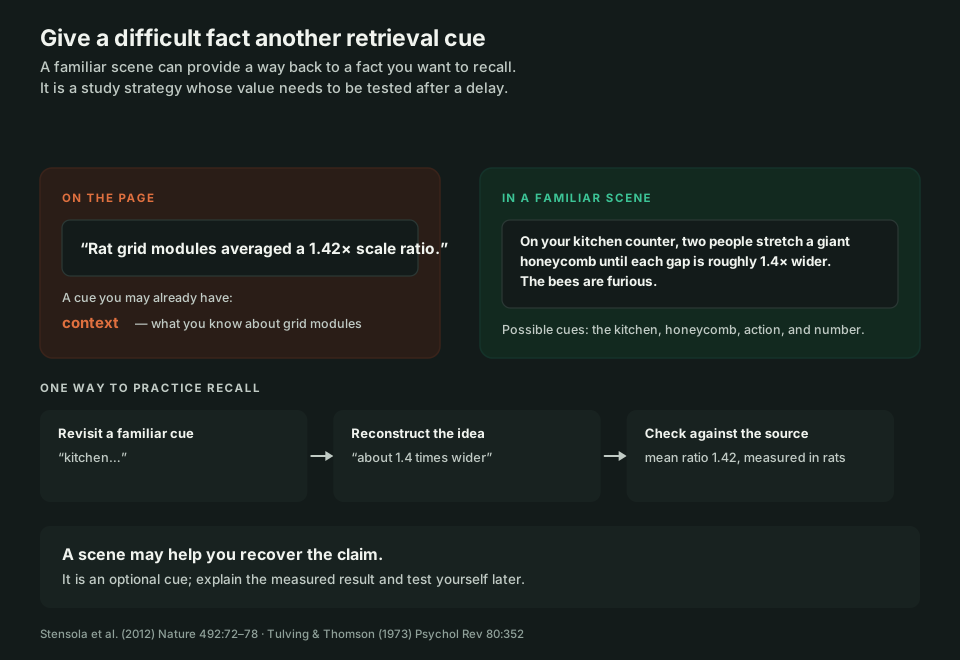
A mnemonic scene offers several possible cues: place, action, and relation. It supplements understanding of the source result; it does not replace that understanding or prove a universal spatial index in the brain.
Build a scene as a cue
For the method we are building, a scene is a useful working unit: it combines a place, objects, and an action that can be revisited. It is not the fundamental unit of every kind of memory.
In 2007, Hassabis and colleagues compared patients with bilateral hippocampal damage with matched controls while they imagined new experiences such as a beach or market. The patients were markedly less able to describe coherent settings.
Some details were present, but their imagined scenes were often fragmented and spatially incoherent. The researchers proposed that the hippocampus may help bind elements into a setting. This small clinical study does not show that every memory is a scene or that every person with amnesia imagines in the same way.
Their scene construction hypothesis links parts of remembering and imagining through a shared constructive process. It is an interpretation of evidence, not a settled account of everything the hippocampus does.
Tulving described episodic remembering as a kind of mental time travel: the experience of returning to a past event rather than simply knowing a fact about it. That description applies to episodes; it does not make a full scene necessary for semantic knowledge.
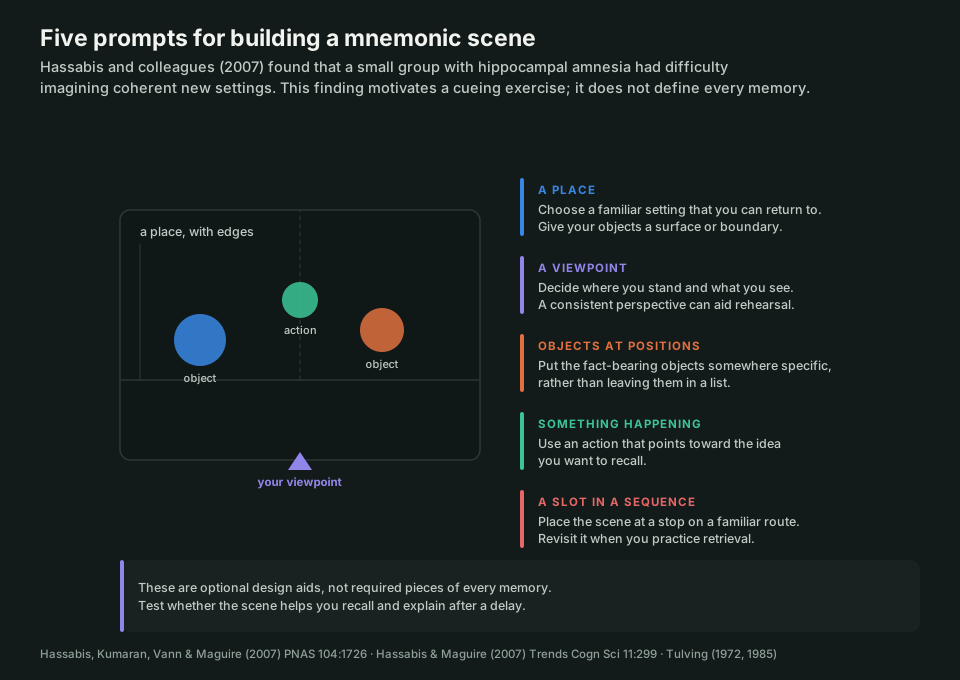
For your own mnemonic, try five ingredients: a familiar place, a viewpoint, objects in positions, an action, and a position on your route. Those are design prompts for building a cue. They are not a one-to-one map from this drawing to five cell types.
The scene works only if it later helps you recover and explain the underlying idea without looking at the illustration.
The cautionary tale
It would be easy to end here with "so remember everything." So it is worth meeting Solomon Shereshevsky.
Shereshevsky was a mnemonist whom Alexander Luria followed for decades. Luria described vivid cross-sensory associations and an elaborate method of loci alongside extraordinary performances on memory tasks.
Luria's case history also describes difficulties that made such memory less straightforwardly useful.
Shereshevsky reported trouble deliberately forgetting and recognizing faces across changing expressions; Luria also described difficulty extracting a general meaning from some passages. This is one person's reported experience, not evidence that using mnemonics causes those difficulties.
The case is a reminder that retaining details and understanding a general idea are different achievements.
The goal is to choose what is worth cueing, then check whether you can use the idea without the cue in front of you.
Where this leaves us
Five parts in, the evidence supports a bounded argument:
Some navigation-related regions show map-like activity during specific nonspatial tasks. A familiar route can also be used deliberately as a retrieval cue. Those findings are related, but they do not establish one mechanism for every thought or prove that an abstract idea is a misplaced spatial object.
The practical skill is building and testing useful cues. Construct a scene when a place and action help; use other methods when they fit the material better. In either case, verify what you can explain after the source is closed.
Part 6 examines method-of-loci training, the evidence for it, and its limits.
Sources
- Constantinescu, A. O., O'Reilly, J. X., & Behrens, T. E. J. (2016). Organizing conceptual knowledge in humans with a gridlike code. Science, 352(6292), 1464–1468.
- Tavares, R. M., et al. (2015). A map for social navigation in the human brain. Neuron, 87(1), 231–243.
- Park, S. A., Miller, D. S., & Boorman, E. D. (2021). Inferences on a multidimensional social hierarchy use a grid-like code. Nature Neuroscience, 24(9), 1292–1301.
- Aronov, D., Nevers, R., & Tank, D. W. (2017). Mapping of a non-spatial dimension by the hippocampal–entorhinal circuit. Nature, 543, 719–722.
- Bao, X., et al. (2019). Grid-like neural representations support olfactory navigation of a two-dimensional odor space. Neuron, 102(5), 1066–1075.
- Bellmund, J. L. S., Gärdenfors, P., Moser, E. I., & Doeller, C. F. (2018). Navigating cognition: spatial codes for human thinking. Science, 362, eaat6766.
- Behrens, T. E. J., et al. (2018). What is a cognitive map? Neuron, 100(2), 490–509.
- Hassabis, D., Kumaran, D., Vann, S. D., & Maguire, E. A. (2007). Patients with hippocampal amnesia cannot imagine new experiences. PNAS, 104(5), 1726–1731.
- Hassabis, D., & Maguire, E. A. (2007). Deconstructing episodic memory with construction. Trends in Cognitive Sciences, 11(7), 299–306.
- Tulving, E. (1972; 1985). Episodic and semantic memory; Memory and consciousness.
- Stensola, H., et al. (2012). The entorhinal grid map is discretized. Nature, 492, 72–78.
- Luria, A. R. (1968). The Mind of a Mnemonist: A Little Book about a Vast Memory. Basic Books.