Machines That Learned · Part 3
Two Winters: How a Field Talks Itself Into a Funding Collapse
Twice, artificial intelligence research lost most of its money in a short space of time. Neither collapse was caused by the technology failing. Both were caused by the gap between what was promised and what arrived, and the pattern is legible enough to be worth knowing.
The question: How did real narrow successes turn into two collapses of confidence?
Big idea: The winters followed repeated gaps between limited working systems and general promises, while useful narrow methods continued to develop.

The phrase "AI winter" first appeared in 1984, as the subject of a public debate at the annual meeting of the American Association for Artificial Intelligence, argued by researchers who had lived through the first one and could see the second arriving. It was coined by analogy with "nuclear winter", and the mechanism they had in mind was a chain reaction: scepticism spreads, funding dries up, the field goes quiet, and the quiet convinces everyone the scepticism was right.
Both winters followed the same sequence. Something genuinely worked. Its success was extrapolated to something much larger. The extrapolation was funded. The larger thing did not arrive, and the money left — taking with it a good deal of work that had nothing to do with the promise.
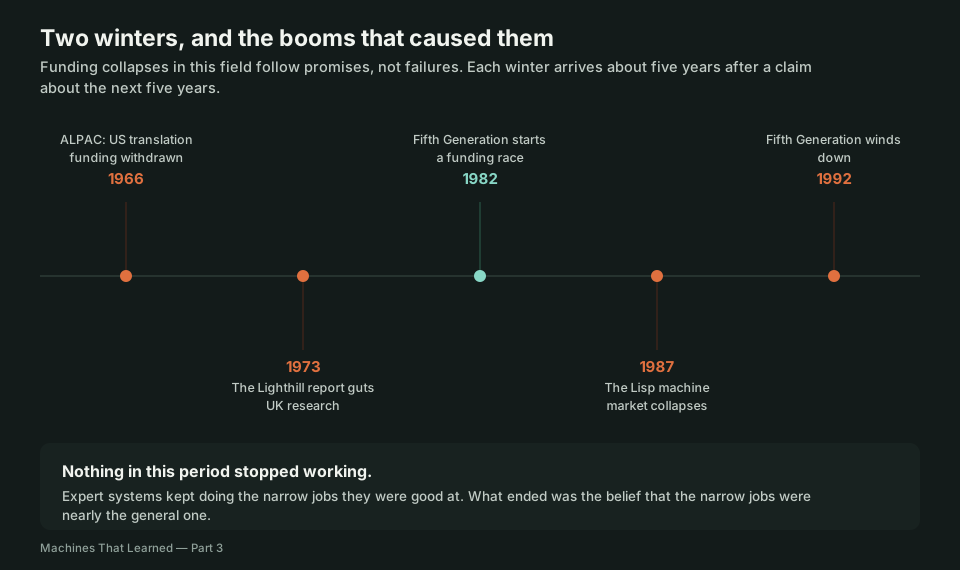
The first winter: translation and Lighthill
Machine translation was an early and heavily funded application, driven in the 1950s by American interest in reading Russian scientific literature. The early demonstrations went well. The extrapolation was that full automatic translation was a few years of engineering away.
In 1966 the Automatic Language Processing Advisory Committee reported to the US government. Its conclusion, after examining a decade of work, was blunt: machine translation was slower, less accurate and more expensive than human translation, and there was no immediate prospect of that changing. Funding for the area largely stopped.
The report is often cited as short-sighted, and it was certainly wrong about the long run. But it was accurate about the present tense, and the reason the researchers were wrong is worth naming: they had assumed translation was a problem of vocabulary and grammar. What they had actually run into was that translation requires knowing what the sentence is about — the same wall part 6 will describe being climbed, by a completely different route, fifty years later.
Britain's version came in 1973. Sir James Lighthill, a mathematician with no stake in the field, was asked by the Science Research Council to review it. His report divided the work into categories and delivered a specific criticism that stings more than a general dismissal would: the field's successes were on toy problems, and its methods suffered from a combinatorial explosion when scaled to realistic ones. Techniques that searched a space of possibilities worked when the space was small and died when it was not.
That criticism was substantially correct at the time. UK research outside a few departments was gutted, and similar pressure hit American funding in the same period.
The boom in between
The recovery came from abandoning generality entirely.
If general reasoning explodes combinatorially, the response was to stop attempting general reasoning and build systems that knew a great deal about one narrow thing. DENDRAL, from the mid-1960s, inferred molecular structures from mass spectrometry data. MYCIN, developed at Stanford in the 1970s, diagnosed bacterial infections of the blood and recommended antibiotics, with a rule base in the hundreds and evaluated performance comparable to specialists.
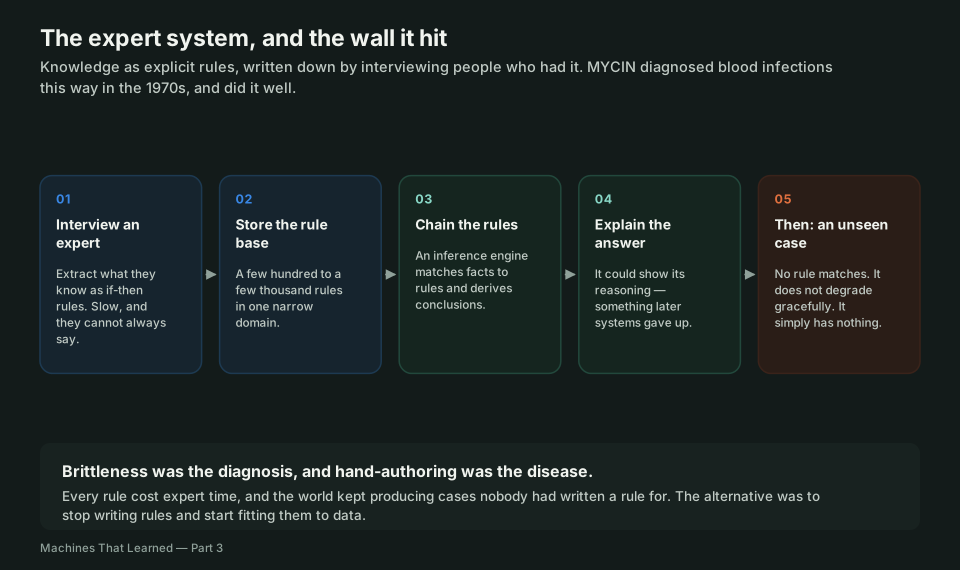
These systems were not toys and their reasoning was inspectable — MYCIN could explain which rules produced a conclusion, a property later systems abandoned and are now trying to recover.
The commercial case arrived with R1, later called XCON, built by John McDermott at Carnegie Mellon and deployed at Digital Equipment Corporation from 1980 to configure VAX computer orders. It was in real production use on a real business problem, and the reported savings ran to millions of dollars a year.
That was the proof that set off the boom. A whole industry formed: expert system shells, knowledge engineering consultancies, and specialised Lisp machines — workstations built to run the language the field preferred. Japan launched its Fifth Generation Computer Systems project in 1982, a ten-year national programme, and the response in the United States and Europe was a funding race.
The second winter
The collapse began in 1987, and its first casualty was hardware.
Specialised Lisp machines were expensive, and general-purpose workstations from Sun and others had become fast enough to run the same software. The market for them did not decline. It disappeared, over roughly a year, taking several companies with it.
The systems themselves hit a different wall, and it was the one visible in the diagram above. Expert systems were brittle. Inside their domain they performed well; a case just outside it produced not a worse answer but no answer, or a confidently wrong one, with no sense that anything unusual had occurred.
They were also expensive to maintain. Every rule was hand-authored by interviewing experts — slow, costly work that ran into a deeper problem: much of what an expert knows, they cannot state. Knowledge engineering was not a bottleneck that better tooling would relieve. It was the method itself.
The Fifth Generation project wound down in 1992 having produced useful work in parallel logic programming and none of the broader capability it had promised. By the early 1990s, researchers were routinely avoiding the phrase "artificial intelligence" in grant applications, preferring "machine learning", "informatics", "knowledge-based systems" — anything else.
What actually survived
Here is the part that gets left out of the winter narrative, and it changes the moral.
Nothing stopped working. Expert systems kept doing the narrow jobs they were good at, often under different names, and rule-based reasoning is still embedded in production software everywhere. What ended was not the technology but a belief — that scaling up narrow success would reach general capability.
Meanwhile the quiet years were not empty. Statistical methods advanced steadily; Vapnik's work on support vector machines and the broader statistical learning theory programme largely defined machine learning practice through the 1990s. Judea Pearl's work on probabilistic reasoning reshaped how uncertainty was handled. Backpropagation was published in 1986, in the middle of the boom, and the convolutional networks that would matter enormously later were trained on real data in 1989.
The winter was a funding condition, not a scientific one.
The pattern, stated plainly
Three collapses in eighty years, and the same sequence each time:
- A genuine result arrives, usually narrow.
- It is extrapolated to a general capability, often by people adjacent to the work rather than doing it.
- The extrapolation attracts money proportional to the general claim.
- The general claim does not arrive on schedule.
- Funding leaves indiscriminately, taking the narrow work with it.
The useful observation is that step two is almost never done by the researchers, and step five almost always lands on them. The specific failure is not optimism about the technology. It is that the claim which attracts the funding is a different claim from the one the results support, and by the time anyone checks, both have the same name.
Part 4 goes back to 1986 and the paper that ended the perceptron's fifteen-year problem — which, like everything else in this history, had been solved before it was noticed.
Sources
- ALPAC (1966). Language and Machines: Computers in Translation and Linguistics. National Academy of Sciences, National Research Council.
- Lighthill, J. (1973). Artificial Intelligence: A General Survey. In Artificial Intelligence: a paper symposium. Science Research Council.
- Lindsay, R. K., Buchanan, B. G., Feigenbaum, E. A., & Lederberg, J. (1980). Applications of Artificial Intelligence for Organic Chemistry: The DENDRAL Project. McGraw-Hill.
- Buchanan, B. G., & Shortliffe, E. H. (1984). Rule-Based Expert Systems: The MYCIN Experiments of the Stanford Heuristic Programming Project. Addison-Wesley.
- McDermott, J. (1982). R1: A rule-based configurer of computer systems. Artificial Intelligence, 19(1), 39–88.
- Crevier, D. (1993). AI: The Tumultuous History of the Search for Artificial Intelligence. Basic Books.
- Russell, S., & Norvig, P. (2021). Artificial Intelligence: A Modern Approach, 4th edition. Pearson.