Build the Palace · Part 3
The Walks: Scheduling Retrieval So the Palace Does Not Quietly Rot
A palace you built and never walked again is a palace you will lose, and you will lose it without noticing, because the images stay visible long after the route stops working. Here is the schedule, why each interval is there, and the six ways it fails.
The question: How do you keep a built palace useful after its images stop feeling new?
Big idea: Walk the route from memory before checking, space later attempts, and repair the specific weak stop or meaning revealed by a miss.

The single most useful finding in the study literature is also the least popular, because it says that the thing which feels like learning is not learning.
Roediger and Karpicke, in 2006, gave students a passage and then split them. One group studied it repeatedly. The other studied it once and then took repeated tests on it with no feedback. Immediately afterwards, the repeated-study group did better and was more confident. Five minutes is where most people stop paying attention to this experiment.
A week later the ordering had reversed, and not narrowly. The tested group retained substantially more. The studied group had been more confident and more wrong.
This is the testing effect, and everything in this part follows from it.
What a walk actually is
So a walk is not "visit the palace and admire the images". It is: arrive at stop one with nothing, wait, and see what comes back. If nothing comes, that is information. Note the stop, move on, and repair it afterwards — not during.
Repairing during the walk is the most common way people convert retrieval practice back into study without noticing. You arrive at stop four, nothing comes, you look it up, you feel the relief of the answer, and you have just performed a rereading. The stop will be blank again next time.
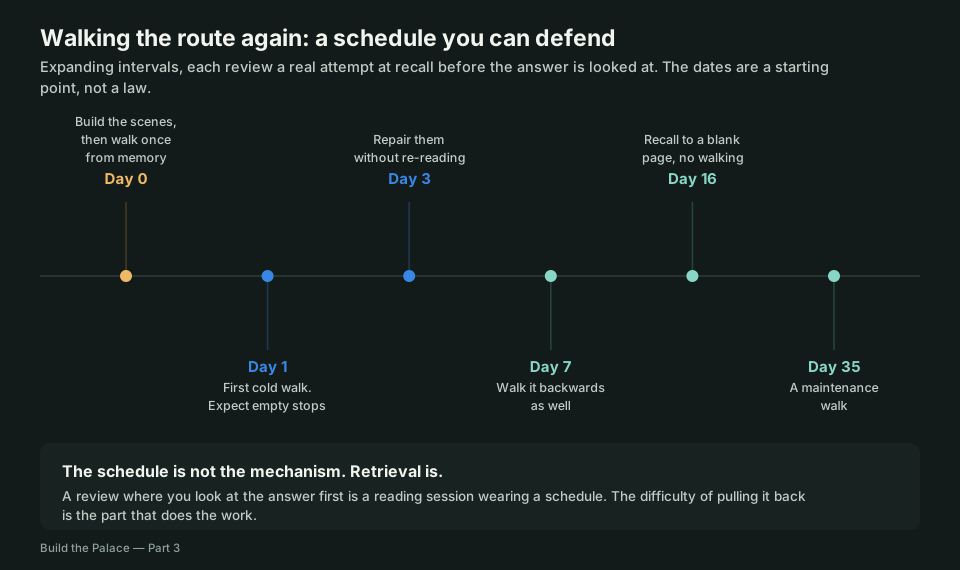
The schedule, and how firm it is
The intervals above are a starting point and should not be treated as more than that. What the literature supports firmly is that distributed practice beats massed practice, and that the gap between reviews should scale with how long you need to keep the material.
Cepeda and colleagues, in a 2006 synthesis of more than 300 experiments, found the optimal gap grows with the retention interval — reviews spaced days apart for material you need in a month, weeks apart for material you need in a year. That is the robust part.
The part that is less settled than the popular version suggests is expanding intervals specifically. Karpicke and Roediger, in 2007, found that expanding schedules helped short-term retention while equally spaced retrieval did better for long-term retention. The headline "always expand your intervals" is not what the data says. If you want a simple rule that is defensible: space them out, make each one a genuine cold attempt, and do not obsess over the exact ladder.
The intervals matter less than the retrieval. This is worth repeating because scheduling is enjoyable and retrieval is not, and people reliably optimise the enjoyable half.
Two additions that are cheap
Walk it backwards. A route learned only forwards is a chain where each stop is cued by the one before it. That is fragile: lose one link and everything after it goes. Walking backwards forces each stop to be retrievable from its own position rather than from its predecessor, and it exposes the weak links directly.
At some point, stop walking. Once the material is solid, do a review where you write the answers on a blank page without the palace at all. If you can, the content has escaped the scaffold and is now yours directly, which is the goal. If you cannot, the palace is still load-bearing, which is fine — but you should know which situation you are in.
Six failures and what each one means
Almost every failure in this method is diagnostic. The symptom tells you which rule got skipped.
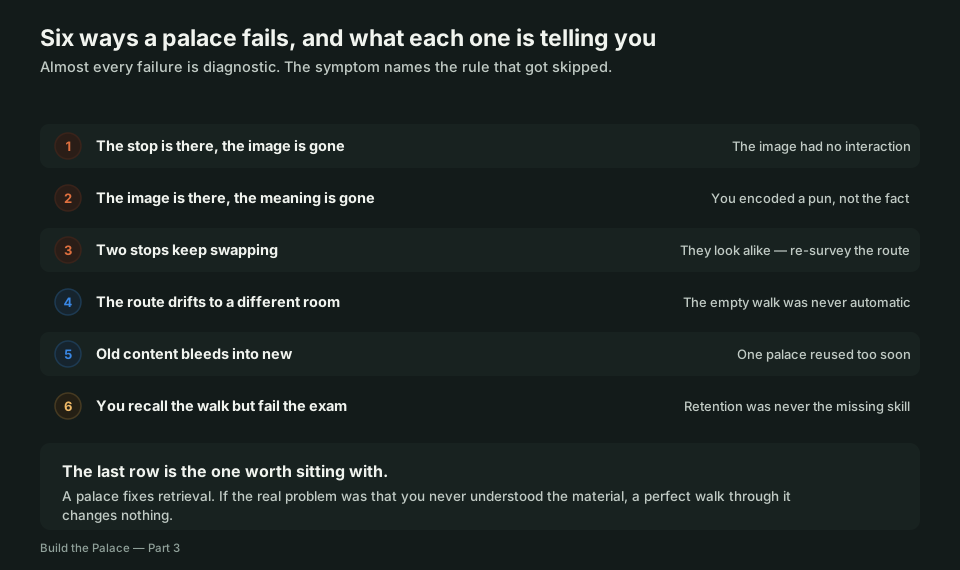
The stop is there, the image is gone. You built a static image. The objects were co-present rather than interacting. Rebuild with one agent doing one thing.
The image is there, the meaning is gone. You encoded a pun instead of a fact. The hippo at stop four problem. Rebuild so the image contains the claim, not the label.
Two stops keep swapping. They look too alike — this is the ad Herennium warning, arriving on schedule two thousand years later. Do not fix the images. Re-survey the route and replace one of the stops.
The route drifts into a different building. The empty walk was never automatic. Go back to part one and do it properly; no amount of content repair will fix an index that moves.
Old content bleeds into new. You reused a palace too soon. Leave it for a few weeks or use a different one. This is why two or three in rotation is the practical minimum.
You can walk it perfectly and still fail the exam. This is the important one, and it is not a failure of the method. It means retention was never your bottleneck. You have proved you can hold the material; if you still cannot use it, what you were missing was understanding or practice at application, and no mnemonic addresses either of those.
Where this sits among study techniques
Dunlosky and colleagues, in a 2013 review that rated ten common study techniques by how well the evidence supports them, gave high utility ratings to exactly two: practice testing and distributed practice. Rereading and highlighting — by a wide margin the two most used techniques among students — were rated low.
Two mnemonic techniques made the list — the keyword mnemonic and imagery for learning from text — and both were rated low. The reasons are worth knowing rather than skipping past: the benefits were real but narrow, tied to particular kinds of material, and in some studies they faded faster than the gains from plain retrieval. The method of loci was not one of the ten reviewed.
That verdict is fair, and it is the honest frame for this whole series. A mnemonic on its own is a specialised instrument. It is extremely good at ordered material you must produce cold, and it is not a general-purpose learning technique. What makes it worth building is that the two techniques rated highest — testing yourself, and spacing it out — are exactly the two that a palace makes structurally easy to do. The route is a test. Walking it is retrieval practice. You do not have to remember to quiz yourself, because there is no other way to use the thing.
Part 4 steps back from the method to the reason it works at all: what moving through space does to learning, and why following directions teaches you almost nothing.
Sources
- Roediger, H. L., & Karpicke, J. D. (2006). Test-enhanced learning: Taking memory tests improves long-term retention. Psychological Science, 17(3), 249–255.
- Karpicke, J. D., & Roediger, H. L. (2008). The critical importance of retrieval for learning. Science, 319(5865), 966–968.
- Karpicke, J. D., & Roediger, H. L. (2007). Expanding retrieval practice promotes short-term retention, but equally spaced retrieval enhances long-term retention. Journal of Experimental Psychology: Learning, Memory, and Cognition, 33(4), 704–719.
- Cepeda, N. J., Pashler, H., Vul, E., Wixted, J. T., & Rohrer, D. (2006). Distributed practice in verbal recall tasks: A review and quantitative synthesis. Psychological Bulletin, 132(3), 354–380.
- Bjork, R. A., & Bjork, E. L. (1992). A new theory of disuse and an old theory of stimulus fluctuation. In From Learning Processes to Cognitive Processes. Erlbaum.
- Dunlosky, J., Rawson, K. A., Marsh, E. J., Nathan, M. J., & Willingham, D. T. (2013). Improving students' learning with effective learning techniques. Psychological Science in the Public Interest, 14(1), 4–58.
- Anonymous (c. 80 BCE). Rhetorica ad Herennium, Book III. Translated by Harry Caplan, Loeb Classical Library, 1954.