The Spatial Mind · Part 1
Why a Familiar Route Can Outlast a New Number
A familiar route may come back more readily than a new string of digits. The contrast raises a useful question: which cues help you find an idea again?
The question: What can a familiar route teach us about cues for a new fact?
Big idea: Repeated experience and rich cues help make a familiar route retrievable; a deliberate spatial cue can also help recover newly learned material.

Close your eyes and picture a home you know well.
You may remember which way the front door swings, a noisy stair, or the route to the kitchen. You may also miss a detail or reconstruct it incorrectly. Repeated visits gave you many chances to learn the place and many cues for finding your way through it.
Now read this number once and look away: 4 7 2 9 1 6 3 8 5.
Can you still produce it? Some readers will; others will lose part of it quickly. The comparison is imperfect: a familiar route has been revisited for years, while the digits are new and arbitrary. That difference makes a useful question possible: what cue could help you find the digits, or a new idea, later?

This series, in one sentence
Over six parts I am going to argue something specific, and then show you how to use it:
The following articles examine where that strategy helps, where other forms of practice matter, and what spatial-memory research can and cannot tell us about ideas.
This first part is about the phenomenon. Parts 2 and 3 are the machinery. Parts 4 and 5 are the discovery that broke the field open. Part 6 is the training protocol.
Two tests, two different limits
If the number was difficult to hold, limited immediate capacity is one possible reason. But that limit does not tell us how much can be recognized after learning.
The famous number is George Miller's "seven, plus or minus two," from 1956. It has been on posters for seventy years. Miller himself wrote about being "persecuted by an integer," noticing a coincidence across experiments rather than announcing one universal limit.
Nelson Cowan's 2001 review argued that tasks designed to limit chunking and rehearsal often reveal a focus of attention of about four chunks. That estimate depends on the task; it is not a fixed quota for everything you can remember.
Four.
Now put that against Lionel Standing's 1973 experiment. He showed people 10,000 photographs, once each. Later he tested them: had you seen this one, or this other one? People got it right about 83% of the time.
That is not a fluke of coarse gist memory, either. In 2008, Brady, Konkle, Alvarez and Oliva showed people 2,500 objects for three seconds apiece, then asked the cruel version of the question — not "did you see a coffee mug?" but "did you see this coffee mug or its near-identical twin?" People scored 87.6%. Asked whether they had seen the same object in the same pose: 87.2%.
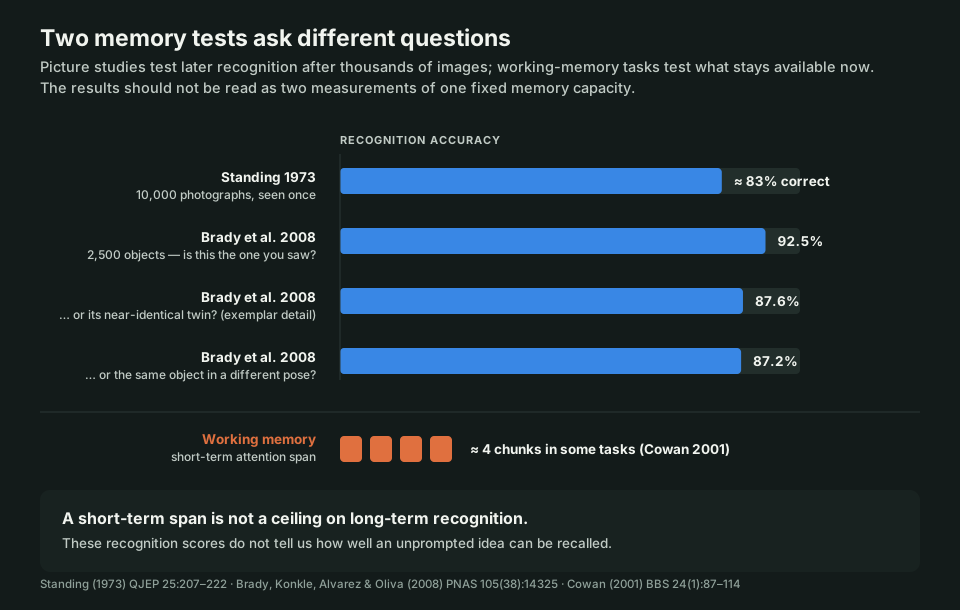
These studies compare immediate maintenance with later recognition. They cannot isolate one bottleneck or prove that memories are stored as spatial maps. They do show why a short-term span should not be mistaken for a ceiling on what people can learn and recognize.
When you need to recall an idea without seeing it again, retrieval cues become part of the problem. A photograph can be distinctive and meaningful; digits can be grouped or rehearsed. A third tactic is to attach new material to a familiar route, giving yourself a cue you can deliberately revisit. In one controlled study, six weeks of method-of-loci training improved delayed word-list recall compared with control training (Wagner et al., 2021). That is evidence for a useful method on tested tasks, not proof that every memory needs an address.
The chart everyone quotes and nobody reads
Whenever someone talks about forgetting, the Ebbinghaus curve appears. It is worth getting right, because the popular version is wrong in three separate ways and the correct version is more interesting.
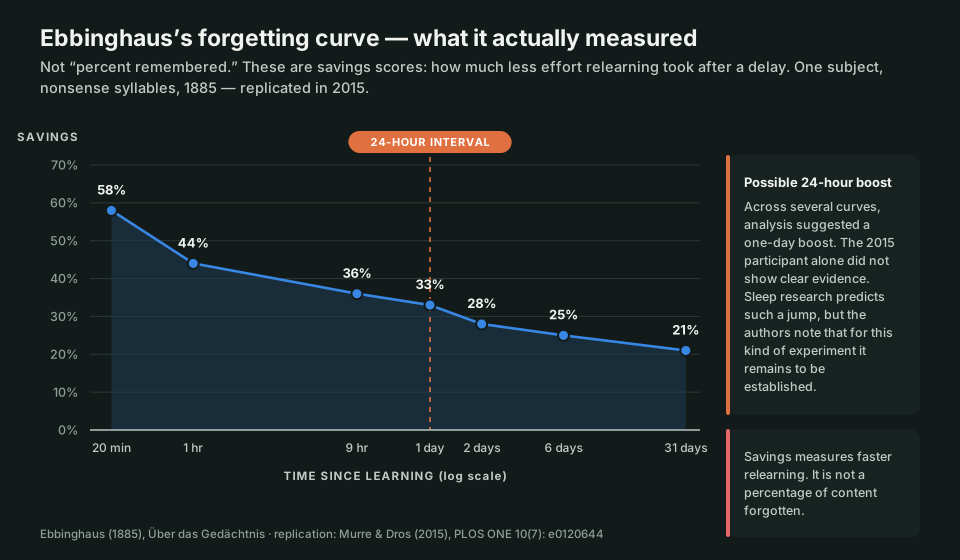
In 1885 Hermann Ebbinghaus memorised lists of nonsense syllables — WUX, ZOL, QAJ — and measured how much he retained over time. His curve is real and it replicates. But:
One. He was measuring savings, not recall. The score is how much less effort relearning took, expressed as a percentage. When you read "you forget 70% of what you learn within 24 hours," someone has silently converted a relearning-efficiency measure into a content-loss measure. They are not the same quantity.
Two. The subject was Ebbinghaus. One man. Memorising deliberately meaningless syllables under rote conditions designed to strip out everything that makes real material memorable. Generalising that to "how people forget things" is a leap nobody has earned.
Three. The curve may not be perfectly smooth. Jaap Murre and Joeri Dros replicated the basic pattern in 2015 with another single subject. Their analysis across several data sets suggested a possible upward jump in savings at the one-day interval; their new participant's data alone did not clearly show that boost. The result does not identify what caused it.
Their own reading is careful: sleep research would predict such a jump, but for this particular kind of experiment, they write, that "remains to be established." Part 2 looks at more direct evidence about consolidation.
Why I care about this, and why you might
I got interested in memory the way most people do: by being annoyed.
Not by forgetting names at parties. By reading something genuinely good — a paper, a chapter, an argument I had worked to understand — and discovering three weeks later that I had kept the feeling of having understood it and none of the content. I could tell you the book was excellent. I could not tell you one thing it said.
That is a specific failure. The feeling of familiarity survived, but I could not reconstruct the argument without the page. Familiarity alone had given me a misleading measure of what I could produce.
Once you start looking, the same failure is everywhere. The student who reread the chapter four times and blanked in the exam. The engineer who has "read about" the thing and cannot use it. The person who has taken a course and retained the syllabus.
None of these examples requires a claim about anyone's hippocampus. They call for a better test: close the source and try to explain the idea. If it is hard to retrieve, a place-based cue may help; so can practicing recall and returning to the idea after a delay.
What is coming
Here is the route through the rest of the series.
Part 2 — How a memory is actually made. Encoding, consolidation, retrieval, and the fourth stage your textbook probably left out. Patient H.M., what one surgery in 1953 proved, and why remembering something changes it.
Part 3 — Recognition is not recall. Different tests that all feel like "remembering," and why a familiar page is weaker evidence of learning than producing an answer without it.
Part 4 — Your mind is a map. Place cells, grid cells, and the evidence for spatial coding, with the limits that headlines often leave out.
Part 5 — The map is not only for places. Researchers observed a grid-like fMRI signal while people navigated a learned, two-dimensional conceptual space (Constantinescu et al., 2016). The finding suggests a way relationships can be represented; it does not make every idea a literal place.
Part 6 — Engineering memory scenes. The method, the evidence it works, the six-week protocol, and an honest account of what it will not do for you.
The one thing to take from Part 1
If a fact is hard to retrieve, give it a cue and test whether that cue helps you produce it later. A familiar route is one option; it works best as a deliberate technique, not as a universal theory of memory.
Sources
- Miller, G. A. (1956). The magical number seven, plus or minus two. Psychological Review, 63(2), 81–97.
- Cowan, N. (2001). The magical number 4 in short-term memory. Behavioral and Brain Sciences, 24(1), 87–114.
- Standing, L. (1973). Learning 10,000 pictures. Quarterly Journal of Experimental Psychology, 25(2), 207–222.
- Brady, T. F., Konkle, T., Alvarez, G. A., & Oliva, A. (2008). Visual long-term memory has a massive storage capacity for object details. PNAS, 105(38), 14325–14329.
- Ebbinghaus, H. (1885). Über das Gedächtnis.
- Murre, J. M. J., & Dros, J. (2015). Replication and analysis of Ebbinghaus' forgetting curve. PLOS ONE, 10(7), e0120644.
- Wagner, I. C., et al. (2021). Durable memories and efficient neural coding through mnemonic training using the method of loci. Science Advances, 7(10), eabc7606.
- Constantinescu, A. O., O'Reilly, J. X., & Behrens, T. E. J. (2016). Organizing conceptual knowledge in humans with a gridlike code. Science, 352(6292), 1464–1468.