Chapter 10 · Run props
Props of the run
Pegs, lids, vessels and racks along the pantry run and the letter rail.
Picture path
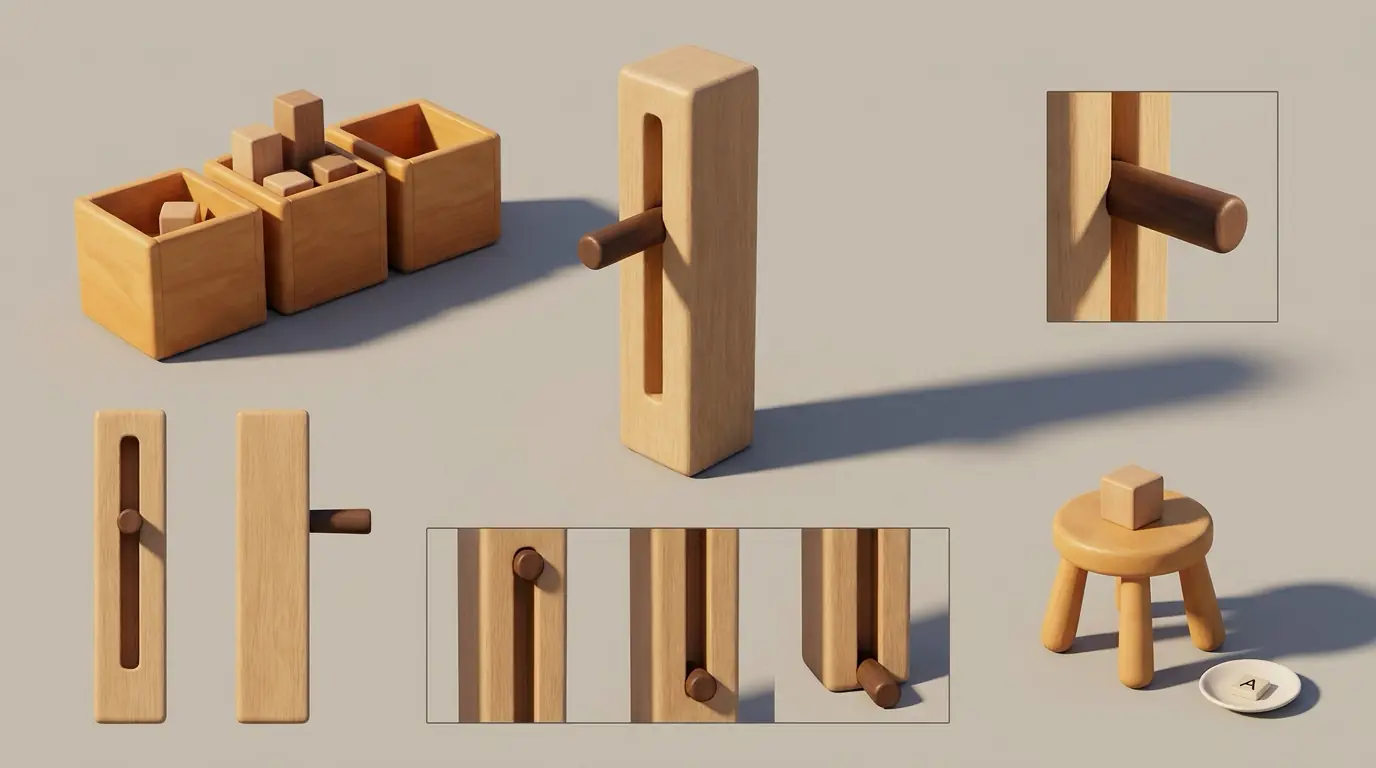
- A dark peg sits partway up a vertical slot in a tall wooden post, with empty track above it. What does the peg record?The peg sits on a height scale, not on the row itself, and it climbs only when something taller beats it.
- A boy pins one block under his arm while lifting a second block out of a bin, right beside an emptied bin. What is the tucked block?The tucked block is not leaving the room; it is bound for the very bin the other block is being lifted out of.
- Wooden blocks lie in a neat row on one end of a plain trestle bench that stands apart from the storage row. What is the bench for?The blocks rest on their own second surface, away from where the originals live.
- Along a wall row of orange bins, the first three lids are flipped open and every later lid is still shut. What does the open stretch mark?Nothing is held up in triumph; the open lids form one unbroken front of finished work.
- Beside three opened bins a boy raises a single block in his hand, and every bin ahead of him keeps its lid on. What just happened?The raised block is the point: the shut lids ahead will now never be opened.
- A boy walks a row of bins opening lids, yet one lid in the middle stays shut while bins past it stand open again. What happened at the shut bin?Check what happens after the shut lid: the walk clearly carried on past it.
- A boy rests one hand on each of two touching boxes numbered 3 and 4 in the same row. What is he checking?Mind the distance between his hands: the two boxes share an edge.
- Two ringed glass jugs face opposite directions, one nearly full while the other has barely started. What do the opposed jugs mean?Count the vessels and note their opposite facing and their opposite progress.
- Small trays sit in a closed circle on a round turntable, a few holding blocks, with one marker peg fixed at the rim. How does this storage work?The circle has no open end; the marker shows where the front currently sits as trays are reused.
- A row of open cubbies stands on a plinth: one cubby is piled with cubes, one holds a single cube, and the rest sit empty. How are things being filed?No cubby wears a tag; where a cube goes is decided by position alone.
- Seven jars stand on one shelf, each filled a little higher than the jar to its left, above a row of card boxes. What does the rising row keep?Every intermediate level is kept in its own jar rather than one jar being refilled.
- A dark wooden case is built as a fixed grid of square compartments; a few hold small piles of white tiles and the rest sit empty. How are counts being kept?The compartments are carved in advance and stay put even when empty.