Chapter 9 · Rooms of record
Rooms of record and machines
Shelves, boards, conveyors, panels and benches: the structures that keep the score.
Picture path
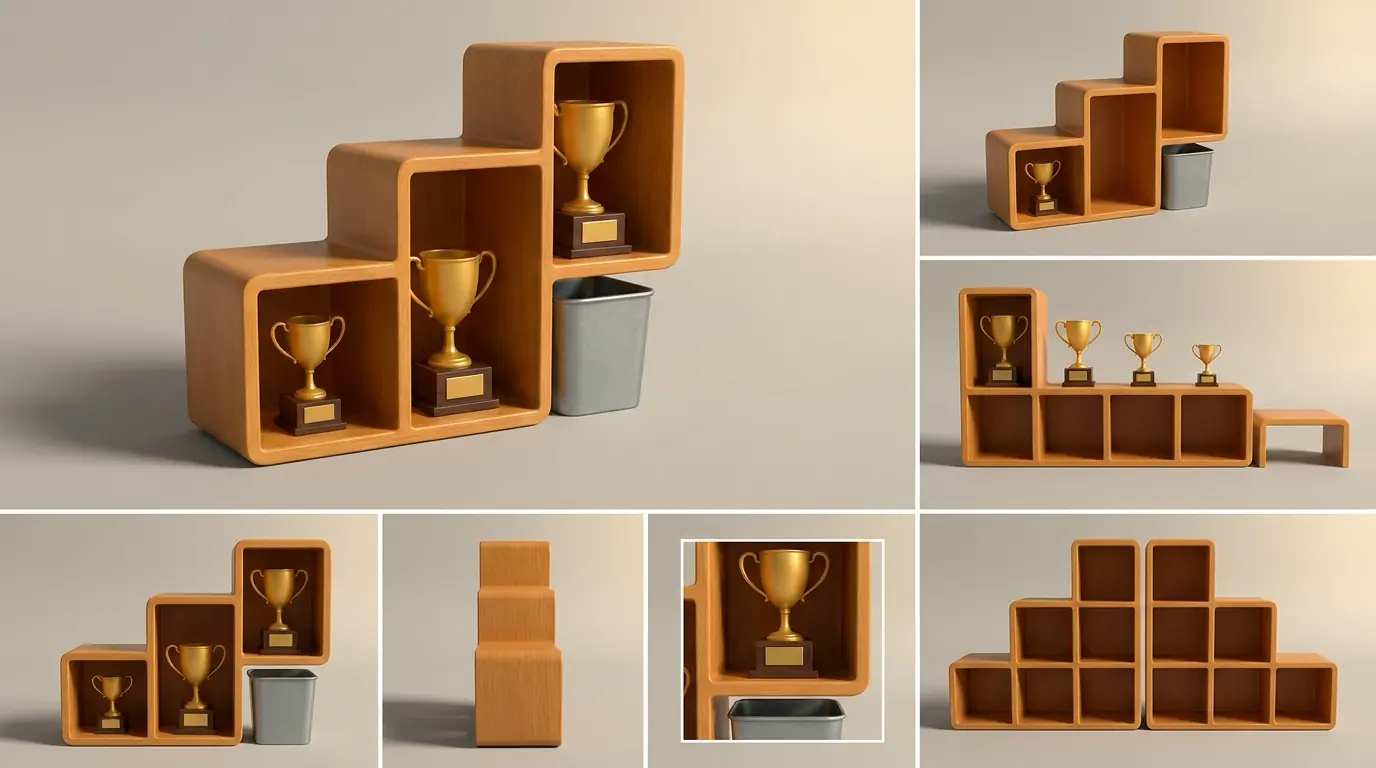
- A stepped shelf keeps its biggest gold trophy in the tallest top cubby, and a metal bin waits beside it for whichever trophy loses its slot when a newcomer arrives. Which structure is this room?Watch the shape and the bin: a vertical shelf whose top slot is the only one ever served, with a bin waiting for whatever loses its place.
- Coloured bars of different lengths lie along a plank board's ledges, each bar stretching a different distance along its ledge, with key tags hanging near a brass rod. What does this room store?Watch the widths: every bar covers a start and an end, not a single spot for a single key.
- Dice-marked parcels ride a moving belt through a three-slot trough while one tumbles off the end chute. What kind of data does this room carry?Notice the belt never stops and never stores: each parcel passes you once and is gone off the chute.
- Inside a wall cabinet, a big brass gear marked 10 meshes down through 5 to 1, each wheel turning the next smaller one. What does this working machine encode?Every gear repeats the same job on a smaller wheel, and the tiny 1 gear is where the turning stops.
- Three doorways open off one stone junction and each corridor hangs its own lantern, some glowing nearer and brighter than others. What kind of map is this room?Each doorway carries its own lamp: the corridors are not equal, and the light prices every step.
- An open wall panel tiers its switches — one big, then two, then four — and one throw of an upper switch controls everything wired beneath it. Which structure is the panel?The upper switches are not just parents: each one acts on the whole stretch of small switches below it in a single throw.
- A cream machine sits open on a workbench: outside, just a slot, a lever and a tray; inside, hands arrange plates and tags to serve them. What kind of room is this?Read the bench, the opened panel, and the few outer controls: the room is about choosing the parts, not running them.
- Between two bins that each hold a block, the middle lidded bin stands open and empty with nothing in anyone's hands. What does that empty slot claim?Check for a carrier: no hand or arm holds the missing block anywhere, so nothing is merely in transit.